
Cross Border Trademark Registrations: Evaluating Direct Filing And The WIPO Madrid Protocol.
Introduction
Expanding a brand internationally is a critical step for many businesses. One of the first strategic decisions is how to protect a trademark in multiple jurisdictions. There are two main routes to secure international trademark protection, i.e., filing applications directly in each country/regional Intellectual Property (“IP”) office, or utilizing the Madrid Protocol, an international system administered by the World Intellectual Property Organization (“WIPO”) that allows one application to cover multiple countries[1].
Both approaches aim to provide exclusive rights over a trademark, but they operate differently in practice. Each route has advantages, limitations, and strategic considerations. This article provides an overview of both routes, compares their benefits, and offers guidance on choosing the right strategy.
Direct National and Regional Filing
Direct filing involves submitting separate trademark applications to each country/regional IP office where protection is sought. Each application must comply with the local requirements, including language, examination procedures, publication, opposition, and registration rules. Regional offices such as the European Union Intellectual Property Office allow protection across multiple member states with a single application, but the examination and registration process is handled by the regional authority[2].
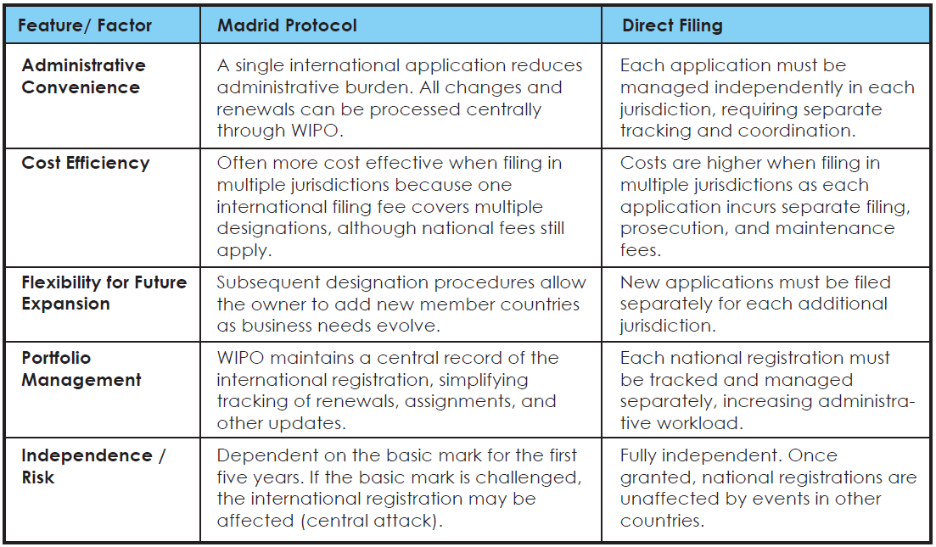
Direct filing is independent, meaning that the outcome of one application does not affect others. Applicants can tailor their specifications to each market, which is particularly important in jurisdictions with stricter examination standards or unique classification practices. Direct registration also provides immediate local rights, which can facilitate enforcement and customs recordation.
Direct filing is mandatory in jurisdictions that are not members of the Madrid Protocol. While the Madrid System covers many countries, businesses targeting non-member states must use the direct filing route. However, filing in multiple jurisdictions separately increases administrative and financial burdens. Each application requires local representation, translations, and separate fees for filing, examination, and maintenance. In addition to the above, certain trademark offices require a Power of Attorney (“POA”) when a foreign applicant appoints a local agent to act on its behalf. A POA is a formal document authorising the local representative to prepare, file, prosecute, and maintain the trademark application. Depending on the jurisdiction, the POA may need to be notarised, attested, or legalised before it is accepted. These processes typically attract additional costs, including notarisation fees, attestation fees, and legalisation fees, as well as international shipping charges to deliver the original executed documents to the foreign agent. As a result, POA requirements contribute further to the administrative and financial burdens of direct filing in non-participating members of the Madric Protocol.
The Madrid Protocol and International Registration
The Madrid Protocol (also referred to as Madrid System) is an international mechanism that allows trademark owners to seek protection in multiple countries through a single international application. Applicants must first have a national trademark application or registration in their home country, known as the basic mark. The international application is submitted through the home IP office to WIPO, which issues an international registration number and forwards it to the designated member countries.
The Madrid System provides administrative efficiency, centralization, and flexibility. Applicants can make changes to ownership, address, and renewals centrally through the WIPO platform. They can also expand coverage through subsequent designations without filing new national applications[3].
However, the Madrid Protocol does not replace national examinations. Each designated office examines the application according to its own laws and can issue refusals or oppositions. The international registration is dependent on the basic mark for the first five years. If the basic mark is refused, cancelled, or withdrawn during this period, the international registration shall be deemed withdrawn, if not converted to a national application or better known as transformation. This is known as central attack rule.[4]
The following is the comparison table between Direct Filing and Madrid Protocol:
Strategic Considerations
The choice between direct filing and the Madrid Protocol depends on business goals, budget, enforcement needs, and risk tolerance.
When to use the Madrid Protocol
It is suitable when:
- The applicant has a strong basic mark in a Madrid member country.
- The goal is broad protection in multiple member countries.
- Centralized management of renewals and assignments is desirable.
- Immediate local enforcement is not critical.
- Flexibility for future expansion is valued.
When to prefer Direct Filing
Direct filing is preferred when:
- The target jurisdiction is not a Madrid member.
- Immediate local rights and enforcement are required.
- There is a need for tailored applications for classification, specification, or legal strategy.
- Avoiding dependency on a basic mark is important.
Many businesses adopt a hybrid strategy, using the Madrid Protocol for broad coverage and direct filing in high-priority markets where enforcement or market presence is critical.
Practical Recommendations
- Before filing, conduct trademark clearance searches in all relevant jurisdictions. Identify key markets for direct filing and other markets suitable for Madrid Protocol coverage. Ensure that the basic mark is solid and defensible to reduce the risk of central attack.
- Monitor registrations continuously, including oppositions, refusals, and renewal deadlines. Even with the Madrid Protocol, local counsel may be required to respond to national office actions.
- A structured filing plan that combines direct filing in strategic markets with Madrid Protocol registrations for broader coverage can optimize both cost and protection.
Conclusion
There is no single correct approach for all businesses. The Madrid Protocol simplifies administration and reduces initial costs for multi-country filings, but it carries dependency risk and does not eliminate national examination. Direct filing offers independence, control, and stronger local enforcement, but requires more administrative effort and cost. A hybrid strategy often provides the best balance, combining efficiency with strong local protection. Careful planning, clearance searches, and proper management are essential to secure enforceable trademarks in international markets.
For further information, please contact:
Muhammad Amirul Rafeeq Aznorashiq, Azmi & Associates
amirul.rafeeq@azmilaw.com
- WIPO, ‘Madrid System – The International Trademark System’ <https://www.wipo.int/madrid/en/>.
- EUIPO, ‘Trade marks’, <https://www.euipo.europa.eu/en/trade-marks/before-applying>.
- WIPO, ‘Managing International Trademark Registrations – Expand Protection’, <https://www.wipo.int/en/web/madrid-system/how_to/manage/designation>.
- WIPO, ‘GUIDE TO THE MADRID SYSTEM: International Registration of Marks under the adrid Protocol’ (updated 2024), WIPO Publication No. 455E/24.