
Introduction
Recently, a seminar themed “Co-examination of New Laws, Mutual Learning and Coexistence”—a comparison of the latest revisions to arbitration laws in China and the UK and a seminar on the forefront of commercial arbitration—was successfully held at the London International Conference Centre. Hosted by the China International Economic and Trade Arbitration Commission (CIETAC), the event brought together senior experts and practitioners in the field of arbitration from both China and the UK. Dr. Dong Xiao, Partner of Junhe Law Firm, CIETAC Arbitrator, and Member of the London Court of International Arbitration, was invited to attend and delivered a keynote speech on hot topics such as building a trustworthy and predictable arbitration legal system, judicial support, and institutional interoperability, addressing shared concerns regarding arbitration law reform in China and the UK.
With the successive implementation of China’s new Arbitration Law and the UK’s Arbitration Act 2025 amendments, the two countries have shown many commonalities in affirming the independence of arbitration agreements, enhancing the transparency of arbitration, and strengthening judicial support for arbitration. Attorney Dong Xiao’s keynote speech, grounded in an international perspective, provided forward-looking insights into promoting the coordinated development and “differentiated coexistence” of cross-border dispute resolution mechanisms, resonating widely with participating professionals from both China and abroad. The following is the content of Dr. Dong Xiao’s speech at this forum, presented for your reading pleasure.
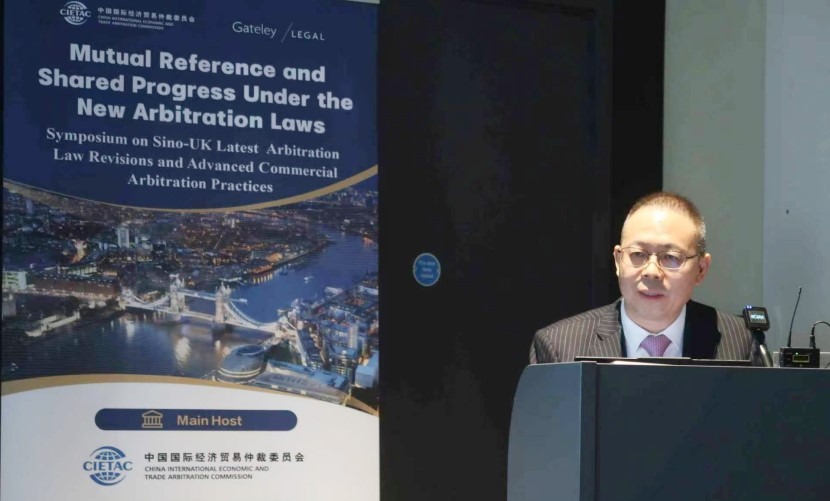
Dr. Dong Xiao delivered a speech at the conference.
Distinguished guests, ladies and gentlemen, good morning, everyone,
It is a great honor to speak here in London—a city that has shaped the very grammar of international arbitration we discuss today. The topic of my presentation is: Convergence in International Arbitration: Building the Legal Architecture of a Shared Future. My message today is simple: international arbitration is converging because cross-border disputes require a common procedural language. Legal systems remain different, and they should remain different. But parties engaged in international commerce increasingly expect the same basic things: neutrality, efficiency, fairness, court support and enforceability. Convergence is therefore not the disappearance of legal diversity. No, it is the building of a shared procedural trust.
Let me walk you through this in four observations.
Point I: The 2025 Reforms: A Shared New Starting Line
Before turning to the broader theme of convergence, I would like to begin with the 2025 reforms themselves. When we place the English and Chinese reforms side by side, at least five areas are particularly worth noting, and together they show that the two systems are responding to many of the same questions in modern arbitration law.
First, the law governing the arbitration agreement. Both systems are concerned with improving certainty in determining the law applicable to the arbitration agreement. This reflects a shared recognition that the arbitration agreement should be treated as an autonomous agreement, not merely as an accessory to the main contract.
Second, the arbitrator’s duty of disclosure. Both reforms pay close attention to the independence and impartiality of arbitrators. This shows that modern arbitration cannot rely only on party autonomy; it must also be supported by transparent and trustworthy decision-makers.
Third, arbitrators’ professional responsibility and immunity. Both systems are seeking to define the proper responsibility of arbitrators, although they approach the issue differently. The deeper common question is how to protect arbitral independence while maintaining accountability for serious misconduct.
Fourth, Interim Measures Supporting Arbitral Proceedings. Based on Section 42 of the new English Arbitration Act, the court may make an order requiring a party to comply with a peremptory order made by the tribunal or the emergency arbitrator. Meanwhile, China’s 2025 Arbitration Law builds on existing provisions for assets and evidence preservation by introducing a new regime of ‘conduct preservation’, in other words, “mandatory injunction”, and grants parties the right to seek such interim measures even before the arbitration is commenced.
Fifth, Judicial Support Extended to Third Parties. Both Sections 44 of new English Arbitration Act and Article 55 of new China Arbitration Law expand judicial assistance beyond the confines of the disputing parties to cover third parties, grant the courts explicit powers over evidence preservation and compulsory collection,
Taken together, these five areas raise an important question: is the similarity between the English and Chinese reforms merely a coincidence? I would suggest that it is not. These reforms reflect a broader movement in international arbitration, where different legal systems are responding to the same practical needs and gradually developing a shared procedural language.
This is the starting point of my speech. The English and Chinese reforms are not identical, and their differences remain important; but their common direction allows us to see convergence not as an abstract theory, but as a living development in contemporary arbitration law.
Point II: Why Convergence Arises: From Human Conflict to Procedural Trust
To understand convergence, we should first place arbitration in the longer history of dispute resolution. Human cooperation has always produced disputes. In earlier times, disputes were often resolved by power, pressure or retaliation. Modern legal systems replaced private force with public adjudication. This was a major step in legal civilisation: conflict became subject to law.
International arbitration represents a further step in that movement from power to process. Domestic courts remain essential, but cross-border disputes create a special problem. Parties from different jurisdictions may not share the same confidence in one national court, one legal culture, or one procedural tradition. Arbitration responds to that problem by offering a neutral process chosen by the parties themselves. It turns international disagreement into an agreed legal procedure.
This explains why arbitration laws in different jurisdictions increasingly move in similar directions. They are not converging simply because one system copies another. They are converging because they face the same question: how can parties from different legal systems trust the same process? The answer is not uniformity. The answer is a sufficient common ground to make arbitration predictable, credible and enforceable. The root of convergence is therefore not imitation, but the search for procedural trust.
Point III: What Convergence Looks Like Today: The Three Layers of Convergence
Convergence in international arbitration can be understood in three layers: functional, legitimacy-based and structural. These three layers help us see that convergence is not an abstract slogan. It has concrete meaning in modern arbitration law and practice. Together, they show what contemporary arbitration systems are trying to achieve.
The first layer is functional convergence. Arbitration laws are increasingly concerned with the same practical problems: delay, cost, tactical obstruction, interim relief, tribunal powers, court assistance and enforcement. These are not minor technical matters. They determine whether arbitration actually works for its users. A process that is too slow, too expensive or too uncertain cannot command commercial confidence. Functional convergence therefore means that arbitration systems are increasingly designed to make arbitration more effective in practice.
The second layer is legitimacy convergence. Arbitration must not only be efficient; it must also be worthy of trust. This is why modern arbitration increasingly focuses on arbitrator independence, impartiality, disclosure, due process, equal treatment and institutional accountability. Party autonomy remains the foundation of arbitration, but party autonomy alone is no longer enough. As arbitration has come to play a central role in resolving major transnational disputes, it must earn authority through procedural integrity. Legitimacy convergence therefore means that arbitration systems are increasingly measured by fairness as well as efficiency.
The third layer is structural convergence. This concerns the basic architecture of arbitration. Across many jurisdictions, arbitration law increasingly revolves around similar concepts: separability of the arbitration agreement, competence-competence, the legal significance of the seat, limited judicial review, court support for interim measures, and recognition and enforcement of awards. These concepts create a common grammar. They allow courts, tribunals, institutions and parties from different legal systems to understand each other. Structural convergence therefore means that arbitration systems are increasingly built around a shared framework.
The 2025 English and Chinese arbitration reforms are meaningful when viewed against this wider background. England and China have very different legal histories, traditions and cultures. Yet both reforms respond to many of the same questions: how to strengthen arbitral autonomy, how to define the proper role of courts, how to improve procedural certainty, and how to align domestic arbitration law with international expectations. The details differ, and those differences matter. But the broader direction shows a common concern with the effectiveness, legitimacy and structure of modern arbitration.
Point IV: Why Convergence Matters: From Similar Rules to a Shared Future
Firstly, convergence matters because the future of arbitration is not sameness, but the ability of different systems to work together. One may call this “interoperability”, but the idea is simple. Legal systems do not need to become identical. Courts, institutions and legal traditions may remain different. But they must be able to communicate, coordinate and support arbitration in a way that international users can understand. The future of convergence is therefore not uniformity, but workable connection.
Secondly, convergence matters because it protects legal diversity while reducing distrust. Common law and civil law systems have different strengths. Chinese arbitration practice, English arbitration practice and other jurisdictions each have their own experience. The goal is not to erase these differences. The goal is to create enough shared principles so that difference does not become uncertainty, and uncertainty does not become distrust. Convergence allows legal systems to remain different without becoming disconnected.
Thirdly, convergence matters because it supports international cooperation before disputes arise. Parties are more willing to trade, invest and cooperate when they know that future disputes can be resolved through a neutral and enforceable process. Arbitration is therefore not only a mechanism used after relationships break down. It is also part of the confidence that allows cross-border relationships to begin. Trust in dispute resolution helps create trust in international cooperation itself.
Finally, convergence matters because it gives the world a legal language for peaceful disagreement. We should not imagine a future without disputes. Legal systems will remain different. Commercial interests will conflict. Contracts will fail. But the real question is whether disagreement can be managed through reasoned procedure rather than power alone. The achievement of arbitration is not that it removes conflict. Its achievement is that it allows conflict to be resolved without destroying cooperation.
Let me conclude with the broader meaning of convergence. In an interdependent world, we need more than contracts, trade and investment. We also need trusted procedures for the moments when cooperation comes under pressure. International arbitration contributes to that task. It offers parties from different legal systems a common method, a common language and a common expectation of justice. That is why convergence in arbitration is not merely a legislative trend. It is part of the legal architecture of a shared future.

For further information, please contact:
DONG, Arthur (Xiao), Partner, JunHe
dongxiao@junhe.com