Getting a last-minute appointment with the embassy makes the entire process seem like a game of rankings. Not all documents are equally important. Start with the embassy’s checklist and brush up on the papers that prove identity and eligibility. In the embassy world, the speed of getting the paperwork done is important, but the correct paperwork is even more essential.
Confirm the required language and certification before ordering. Rapid Translate states that its urgent translation services can deliver some urgent documents in less than 12 hours, while standard delivery is 24 hours. Expedited orders may cost more. These estimates do not determine embassy acceptance. The receiving office still decides whether certification, notarization, or another form is required.
Requirements can differ between consular posts. The U.S. Embassy in Kyiv requires certified English translations only for records not issued in English or Ukrainian. The U.S. Consulate in Singapore requires certified English translations for non English records and says they must be validated before a notary.
Start With the Embassy Rule
Open the appointment notice, embassy checklist, and application portal first. Mark every document described as original, translated, certified, notarized, or uploaded in advance. U.S. immigrant visa guidance tells applicants to bring original civil documents and required translations to the interview. It also directs applicants to instructions for the specific embassy. A general checklist is only the starting point.
Create a one page control sheet. Use columns for document, required form, status, and deadline. Add the person connected to each record. Missing pages become visible before ordering.
Use this first review order:
- Confirm the accepted language.
- Mark every record requiring translation.
- Check whether certification or notarization is required.
- Separate originals, copies, and upload files.
- Note what must be brought to the appointment.
Rank Documents by Consequence and Replacement Time
Use two questions for every document. Is it central to the visa decision? Can it be replaced before the appointment? Essential records with long replacement times come first.
Priority One: Identity and Civil Records
First, you will have to translate civil documents including birth, marriage, divorce, adoption, death and police records. They provide you with information regarding your identity, family status, and legal history. Civil documents play a role in U.S. immigration applications whereas police records in Canada must be certified and translated if they are in any language besides French or English. Be sure to check every stamp and the inside of each document as any missing element can harm the whole process.
Priority Two: Evidence of Eligibility
Then it is necessary to provide documents that support the intent or legal basis of the petition. The relevant documents can include employment, education, sponsorship, legal, or financial documents. The proper group should be chosen according to the type of visa. For example, work-related case and family-related case would require different types of evidence.
Do not translate only the sentence that appears important. Dates, duties, salaries, account names, and official stamps may carry essential details. UK visitor guidance requires a full translation that can be independently verified. It also lists information that must identify the translator.
Priority Three: Supporting and Replaceable Evidence
Supporting evidence comes after required identity and eligibility records. Extra statements and duplicate proof may still help. They should not delay mandatory documents.
Replacement time can change the order. A bank statement may be downloaded again quickly. A police certificate or court record may take much longer. Translate the slower record first when the file is already available. Leave replaceable material for the final review.
Some records need no translation. U.S. guidance says translation is not required when a document is in the language of the country where the interview takes place. A consular post may apply a narrower rule. Confirm the exception before removing anything from the order. This prevents wasted time and cost.
Audit Files Before Ordering
A rush order cannot repair an incomplete scan. Compare every name with the passport. Check birth dates, document numbers, case references, and marriage dates. Include pages with seals or handwritten notes. Keep every edge visible. Rotate pages before uploading. U.S. guidance requires scans to be clear, complete, and correctly oriented.
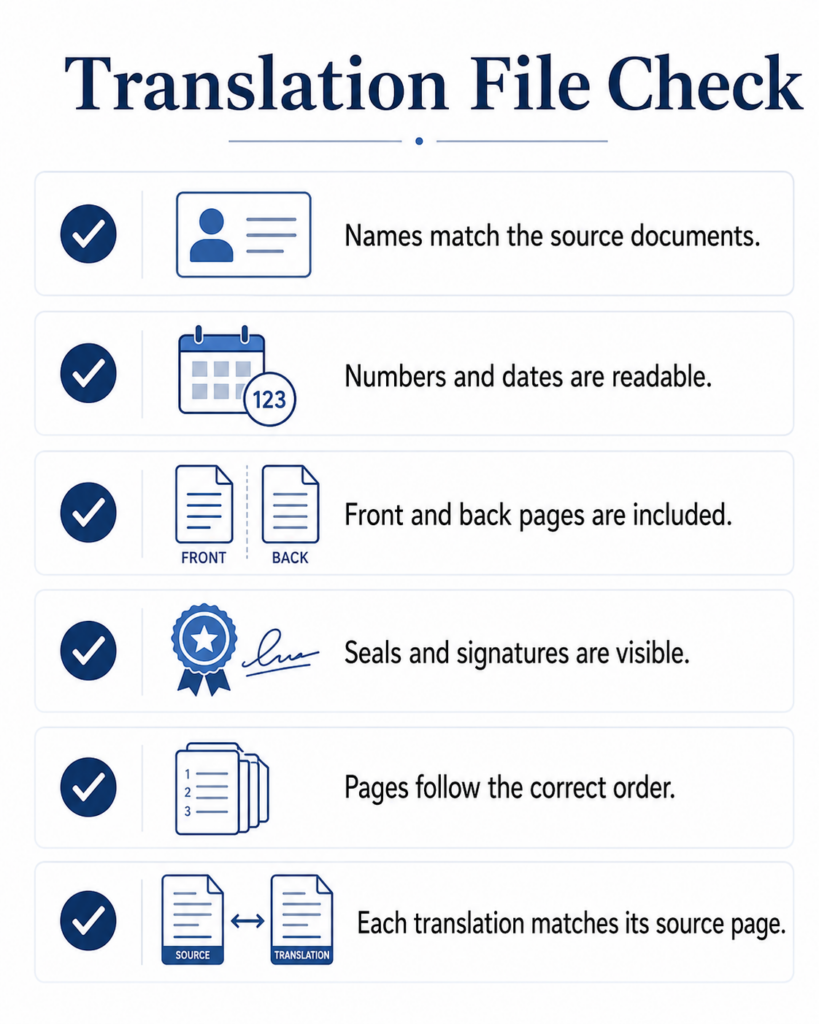
Proof of name differences must be provided separately. This may include the marriage certificate, divorce record, or legal name change document for earlier surnames. Spelling must remain consistent with the original document.
Refer to the wording of the certification as well. The American immigration visa advice requires a signed statement attesting to the accuracy of translations and the qualification of the translator. The visitor information UK advises to include the date, name, signature, and contact information in the same manner.
Combine files only when the instructions allow it. The U.S. National Visa Center says the original and certified translation should appear in one file, with the original first. Another embassy portal may use a different sequence. Follow the receiving office.
Control the Final Twenty Four Hours
Set an internal deadline before the appointment. Leave time to compare the completed translation with the source. Check names and numbers before layout. Open the PDF on another device. Print copies when required.
Keep passports, appointment letters, originals, copies, and translations in labeled groups. Store digital copies in a secure folder that opens without public internet. Do not edit a certified file after delivery.
Confirm whether records must be uploaded or carried to the interview. U.S. guidance says translations not previously sent to the National Visa Center must be presented on the interview day. Save proof of upload or delivery when available. Recheck the appointment notice before leaving.
Conclusions
A last minute embassy appointment rewards correct ordering. Start with the exact consular instructions. Translate required civil records before optional support. Then handle evidence that proves eligibility and is hard to replace.
Use the final hours for verification, not random additions. Review names, numbers, page order, certification wording, and delivery method. Urgent translation can solve a timing problem. A clear priority system solves the document problem.