
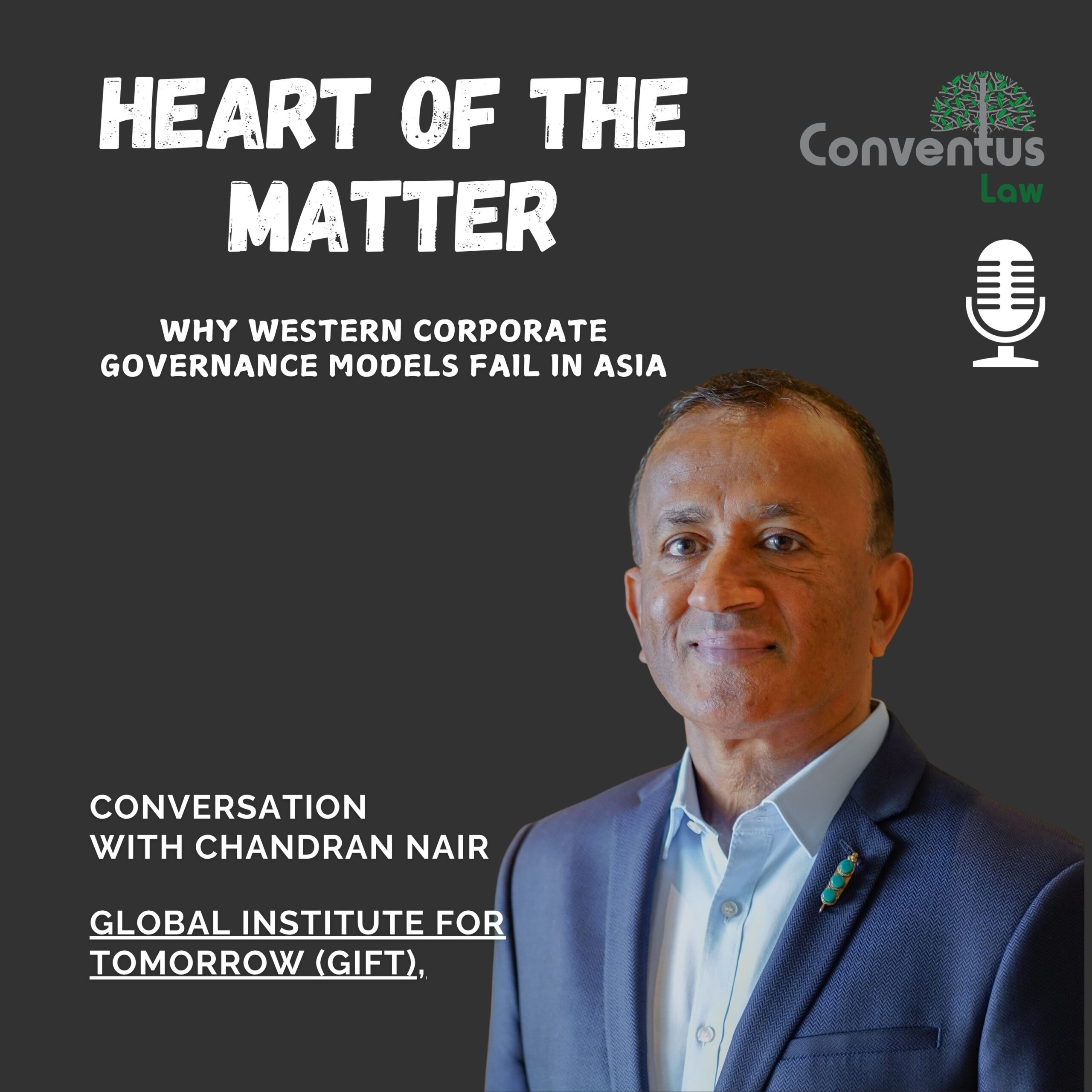
Why Western Corporate Governance Models Fail in Asia
Twenty years after challenging a Western speaker’s paternalistic lecture on governance, Chandran Nair hasn’t softened his position one bit. If anything, his conviction has only grown stronger.
Nair, founder and CEO of the Global Institute for Tomorrow, sits down with Ajay Shamdasani to dismantle the assumption that Anglo-American corporate governance models are the global standard worth emulating. Repeatedly, the evidence points elsewhere. The 2008 financial crisis originated in the United States despite rigorous regulations already in place, and scandals keep emerging from systems supposedly built on sound governance principles.
Could the real problem be that Western institutions like the Big Four auditors and rating agencies serve their own interests rather than the public good?
(Nair’s point about European family offices being just as opaque as any Asian business is particularly sharp.) Critically, he argues that effective governance depends on genuine state capacity to enforce accountability. Malaysia shows what happens when institutions are too weak to constrain powerful actors, while China demonstrates that real consequences, not routine fines, create meaningful accountability.
Nair also calls out lawyers and compliance officers who stay silent to protect their paychecks, choosing financial security over ethical responsibility.
Tune in for a conversation that genuinely challenges assumptions about governance, power, and who gets to write the rules.
Our Guest
Chandran Nair
Chandran Nair is the Founder and CEO of the Global Institute For Tomorrow (GIFT), an independent pan-Asian think tank based in Hong Kong and Kuala Lumpur focused on advancing a deeper understanding of global issues including the shift of economic and political influence from the West to Asia, the dynamic relationship between business and society, and the reshaping of the rules of global capitalism.
He is the author of Understanding China: Governance, Socio-Economics, Global Influence, Dismantling Global White Privilege: Equity for a Post-Western World,The Sustainable State: The Future of Government, Economy, and Society and Consumptionomics: Asia’s Role in Reshaping Capitalism and Saving the Planet and the creator of The Other Hundred, a non-profit global photo journalism initiative to present a counterpoint to media consensus on some of today’s most important issues.
Chandran was chairman of Environmental Resources Management (ERM) in Asia Pacific until 2004, establishing the company as Asia’s leading environmental consultancy.Chandran is a member of WEF’s Global Agenda Council on Governance for Sustainability and Experts Forum, he sits on the Global Steering Committee of CISL’s Business for Sustainability Programme, is a member of the Club of Rome, is a Senior Fellow of CIMB ASEAN Research Institute (CARI), as well as a Fellow of the Royal Society of Arts.
Chandran has served as Adjunct Professor at the Hong Kong University of Science and Technology and the Lee Kuan Yew School of Public Policy in Singapore and is a former Advisor to ORIX Corporation and a former member of the Stakeholder Advisory Council for BASF, the world’s largest chemical company as well as the Executive Committee of the Club of Rome, the world’s premier scientific think tank.
Our Host
Ajay Shamdasani
Ajay Shamdasani is a veteran writer, editor and researcher based in Hong Kong. He holds an AB in history and government from Ripon College, JD and MIPCT degrees from the University of New Hampshire Franklin Pierce Law School, and an LLM in financial regulation from the Illinois Institute of Technology’s Chicago-Kent College of Law.
His 15-year long career as a financial and legal journalist began as deputy editor of A Plus magazine – the journal of the Hong Kong Institute of Certified Public Accountants. From there, he assumed the helm of Macau Business magazine as its editor-in-chief, and later, joined Asialaw magazine as its deputy editor.
More recently, he spent close to seven years as a senior correspondent with Thomson Reuters’ subscription-based trade-wire service Regulatory Intelligence/Compliance Complete (previously called Complinet) in Hong Kong. While there, he covered regulatory developments in that city, as well as Singapore, India and South Korea.