
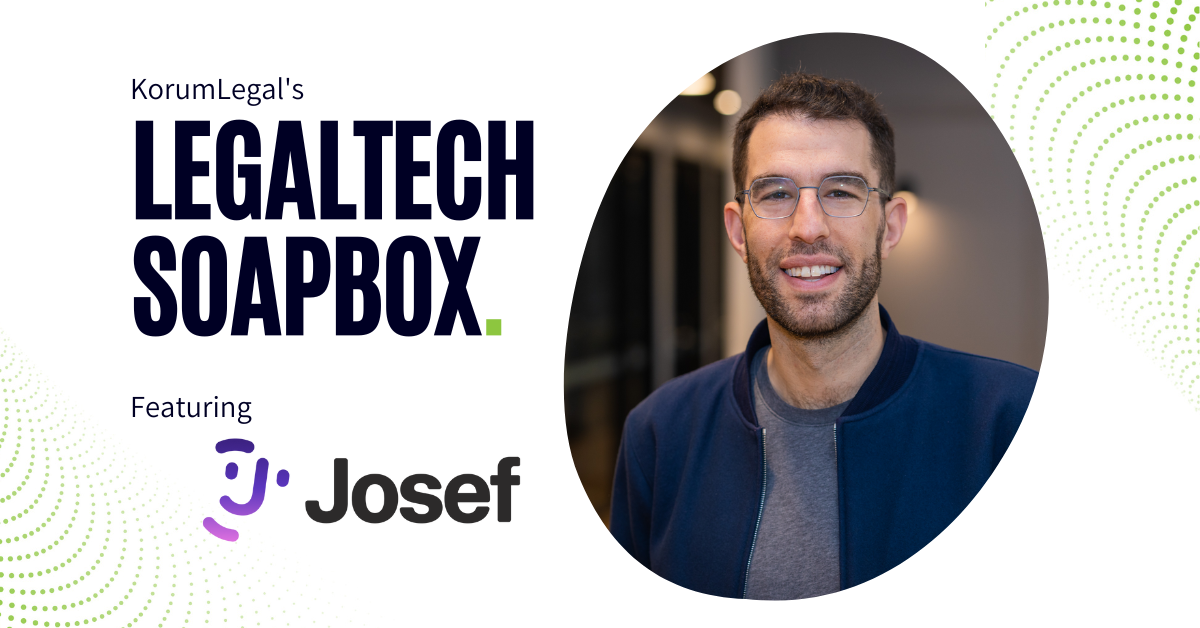
1. Hi Tom, tell us the story behind Josef
We started Josef because we had seen so many different ways in which the delivery of legal services could be improved with good technology.
Our vision was to create a platform where anyone could build the automation tools they needed to make the services they deliver more accessible to more people, more often. That vision led to the creation of Josef, a no-code automation platform where any legal professional, regardless of technical experience or skills, can build, maintain, update, and control their own automation tools.
It’s a vision that has led us to work with organisations all over the world from the smallest community-based legal assistance organisations to some of the largest law firms in the world, alongside in-house legal teams, not-for-profits and Fortune 500 companies.
More recently, we developed our second product, Josef Q, a generative AI-powered platform that provides hyper-accurate and reliable answers to questions about legal and compliance content.
For us, it was simply an extension of our original vision: How do we make the legal help people need more accessible?
We see this moment in LegalTech as one of the most exciting since we began because this combination of workflow automation and generative AI is opening up a whole universe of use cases that previously weren’t possible and it’s enabling us to solve problems that we simply couldn’t solve before.
2. What are the services or products that Josef provides?
Josef is a legal automation platform. Our customers use Josef to build self-service tools that their clients can use to solve their legal problems. Whether those tools are generating documents or they’re helping people assess their legal rights and obligations or they’re answering some of the hardest and most business-critical questions in an enterprise.
Our platform is seriously no-code, which means it’s designed with non-technical users in mind—the sorts of people you find in law firms or legal teams, who have the subject matter expertise and know exactly what their clients need, who are the experts in the legal and compliance issues that their clients need to solve, but who might not be technology experts. These are the people who can build bots and tools on our platform to solve their clients’ problems.
3. How does the above optimise the daily operations of an in-house legal team/ law firm?
The most important thing our customers do with Josef is create self-service experiences. This means their clients can access the help they need 24/7. They can generate their own documents, get answers to their questions, enabling them to then go off and do their work whenever and wherever they need to.
This frees legal teams and law firms from high-volume, mundane, cookie-cutter work—the kind of tasks that no-one wants to be doing anyway, the repetitive stuff that makes it hard to get out of bed in the morning. Instead, they can focus on high-value, strategic work, knowing their clients are getting the help they need with the more routine tasks on demand.
4. What do you believe will be the most significant change in how in-house legal teams use technology in the next 10 years?
If you’d asked me that question three years ago, generative AI wouldn’t have been part of my answer. If you’d asked me two years ago, when we were already building with large language models, it absolutely would have been. But even we couldn’t have predicted the pace of change we’ve seen over the last two years. So, with that caveat, I’ll try to answer the question.
I believe generative AI is the broader technology that will drive the most significant transformation in how legal teams work over the next 10 years. But I don’t think it’s just going to change a lawyer’s day-to-day work. It’s going to be felt in the kind of unseen places, like the way law firms charge for their work.
I think time-based billing is in the firing line. It’s going to change how enterprises structure their legal teams, who they hire, and what their roles involve, as AI reshapes what day-to-day legal work looks like.
At the moment, a lot of people are asking, ‘What can I do with a co-pilot? How can I use it to make myself 5%, 10%, or 20% more efficient?’ But in 10 years, I’m not sure that the things that lawyers are currently using co-pilots for will be done by lawyers at all.

KorumLegal is a boutique legal consultancy committed to providing value innovation in legal service delivery. The legal services industry is continuing to change with ‘NewLaw’ – and clients are seeking more innovative and cost-effective solutions without compromise on experience and quality
