
Patent intelligence software can help you find prior art, investigate competitors, and assess patent portfolios. But finding documents is only part of the job.
You also need to verify evidence, understand technical disclosures, and share findings with the people making legal and commercial decisions.
Some platforms focus on detailed patent searching. Others offer AI-assisted research, portfolio analytics, or ongoing competitor monitoring.
We’ve compared seven patent intelligence platforms to help you understand what each offers, where the differences matter, and what to check before choosing.
The 7 leading Patent Intelligence Platforms Compared
| Platform | Key Capabilities | What to Consider |
| 1. Minesoft Origin | Agentic AI workflows, patent search, custom classification, monitoring and collaboration | MAIA access, licensing and customer support arrangements |
| 2. Questel Orbit | Advanced search, Sophia AI and patent-family analysis | Training requirements and AI usage limits |
| 3. IPRally | AI novelty and invalidity agents, feature-level analysis | Specialist focus and subscription access |
| 4. PatSnap Analytics | Patent analytics, Hiro AI and shared workspaces | Additional products and licensing |
| 5. Clarivate Derwent | Expert-enriched patent records and AI search | Enterprise pricing and separate data products |
| 6. LexisNexis PatentSight+ | Portfolio benchmarking, ownership analysis and Protégé AI | Focus on portfolio analytics rather than claim-level research |
| 7. Patlytics | AI claim charts, infringement and invalidity analysis | Specialist legal workflows and AI verification |
Most of these platforms use quotation-based pricing. The features available will depend on your license, user requirements, and any additional AI products.
- Minesoft Origin: Best Overall Patent Intelligence Platform
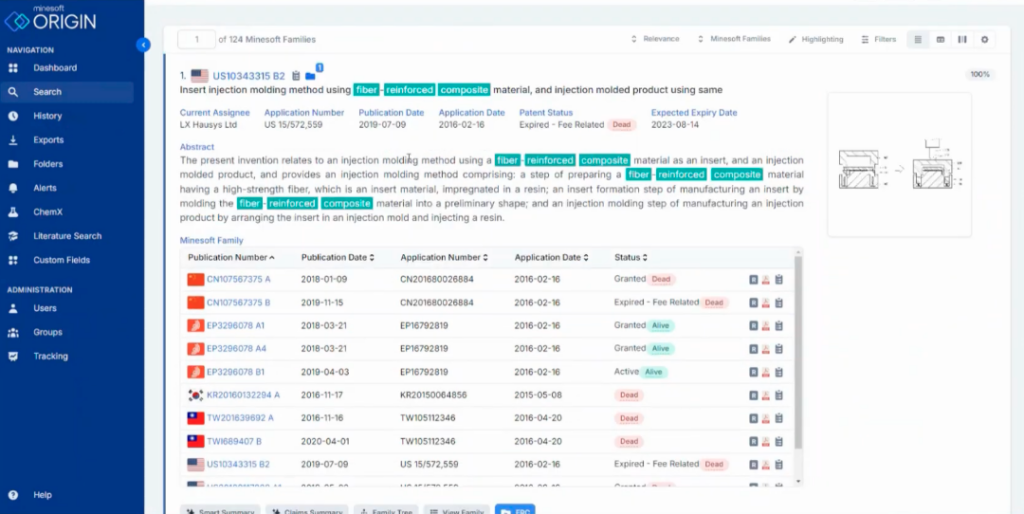
Minesoft Origin combines patent searching, analysis, monitoring, and collaboration in one platform.
You can use natural-language search, AI highlighting, document chat, and claims comparison to investigate relevant patents. But its main advantage is how it helps you organize and use the findings.
For example, an IP department supporting battery development could classify patents by electrolyte chemistry, recycling technology, or individual R&D projects.
Origin’s custom AI classification allows you to use your own technology categories instead of relying entirely on standard patent classifications.
You can also monitor competitors, prioritize relevant new filings, and share findings with engineers, legal colleagues, and R&D teams.
This is particularly useful when your responsibilities extend beyond individual patent searches.
Minesoft also offers MAIA, an AI assistant integrated with Origin that uses an agentic approach to patent research. Rather than simply responding to individual prompts, MAIA coordinates specialist AI agents to carry out multi-step workflows for novelty, invalidity and freedom-to-operate (FTO) investigations.
These agents can help develop search strategies, identify relevant prior art, analyse technical features and prepare evidence-based reports. Human checkpoints are built into the process, allowing researchers to review findings and approve decisions before the workflow continues.
Minesoft also places a strong emphasis on customer success, with dedicated support teams available across time zones and customer feedback helping shape ongoing product development.
Key strengths:
- AI-assisted patent search and document analysis.
- Agentic AI workflows for multi-step patent investigations, with human oversight.
- Custom classification based on your technology priorities.
- Relevance-ranked monitoring and competitor tracking.
- Collaboration across legal, engineering, and R&D teams.
- Dedicated customer success and responsive technical support.
What to consider: Check which MAIA capabilities, configuration services and user permissions are included in your licence. Ask about onboarding, training and the level of ongoing customer support available.
Our assessment: Minesoft Origin is our best overall choice because it connects patent research with ongoing intelligence and collaboration. You can move from finding relevant documents to organizing, monitoring, and sharing information that supports business decisions.
- Questel Orbit Intelligence: Advanced Patent Search and Analytics
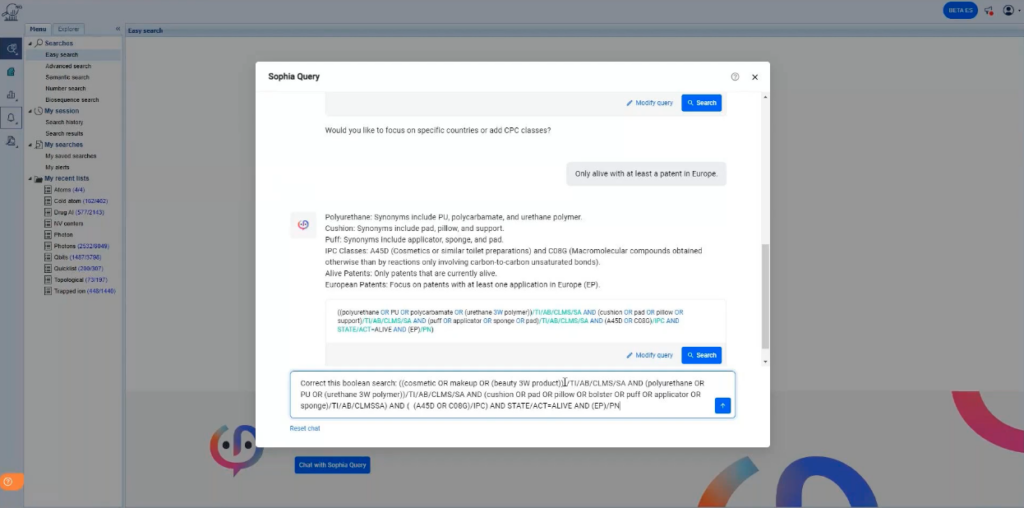
Questel Orbit combines traditional patent searching with AI-assisted technical analysis.
You can build detailed Boolean and proximity searches, investigate patent families, examine legal-status information, and analyze patent portfolios.
Its FamPat collection helps you understand relationships between patent applications across jurisdictions.
Questel’s Sophia AI tools add natural-language query development, semantic searching, and technical feature analysis.
For example, you could investigate a mechanical invention using conventional queries, then use semantic searching to identify documents that describe similar technical features using different terminology.
Orbit also includes portfolio analytics, monitoring, and reporting tools.
Key strengths:
- Detailed Boolean, proximity, and classification searching.
- Patent-family and legal-status analysis.
- Sophia AI for semantic and technical searches.
- Portfolio analytics and reporting.
What to consider: Advanced searches may require specialist experience. Some Sophia capabilities also have license restrictions and monthly usage allowances.
Questel provides considerable research depth, although you’ll need to assess how its searching and reporting features fit your wider workflows.
- IPRally: AI-Powered Prior-Art Research
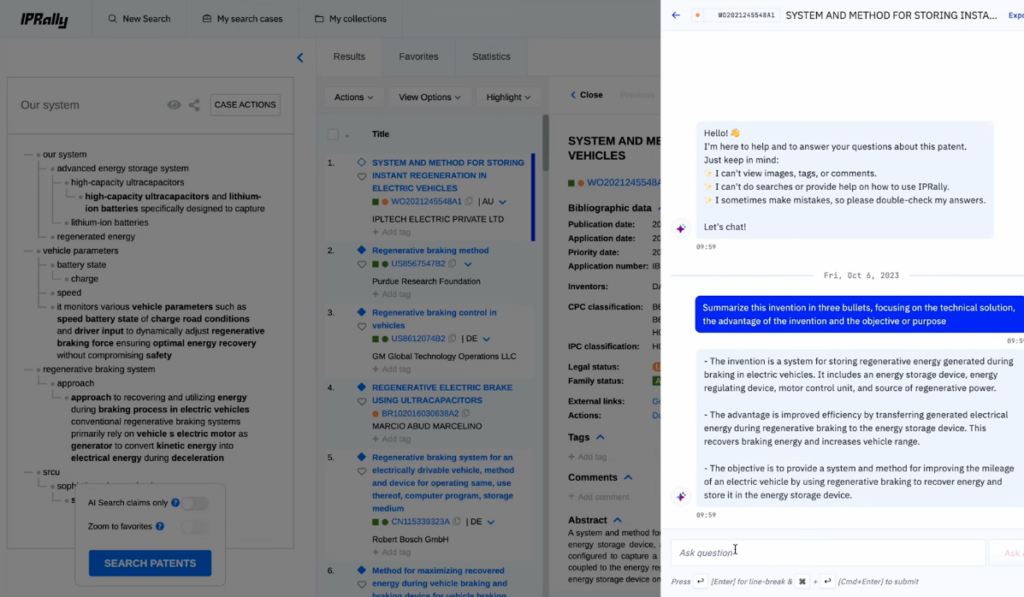
IPRally uses AI to investigate technical similarities between inventions.
Instead of relying solely on matching keywords, it examines technical features and their relationships.
Its Novelty Search Agent can analyze an invention disclosure, identify features, search for prior art, and prepare a report.
The Invalidity Search Agent follows a similar process using an existing patent and selected claims.
You can inspect feature charts that connect technical elements to supporting patent passages, making it easier to review the evidence.
The platform also lets you adjust relevance assessments and manually investigate results.
Key strengths:
- AI-assisted novelty and invalidity investigations.
- Searching based on technical features.
- Evidence-linked feature charts.
- Reviewable research reports.
What to consider: Agent availability depends on your subscription, and some investigations may require additional research sources.
IPRally’s approach centers on structured prior-art analysis. If you also need extensive competitor monitoring and collaboration, compare those requirements with the capabilities it offers.
- PatSnap Analytics: Patent and Technology Intelligence
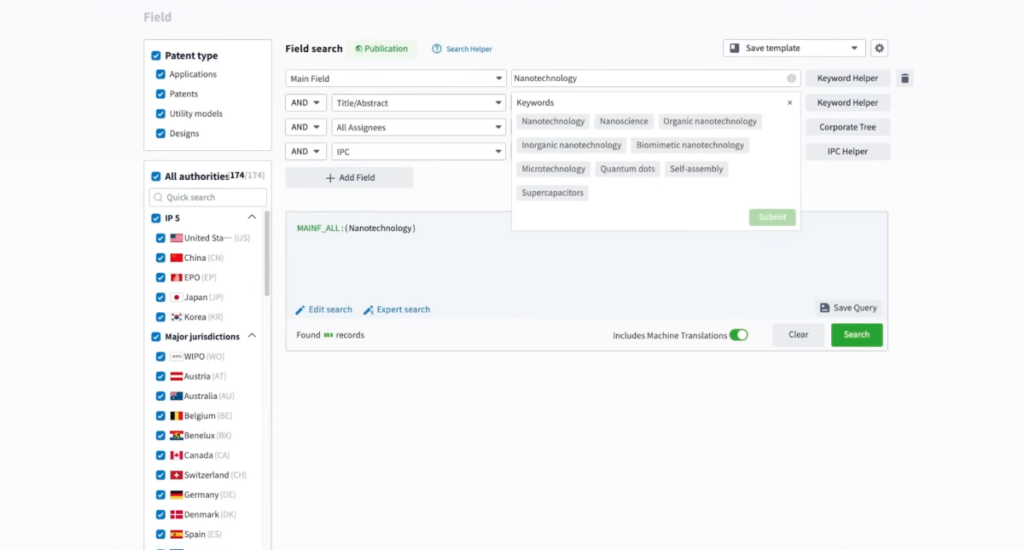
PatSnap Analytics combines patent searching, portfolio analysis, competitor monitoring, and technology intelligence.
You can investigate patent families, examine technology trends, and analyze competitors’ filing activity.
Its Hiro AI assistant lets you ask questions about portfolios and technologies in natural language.
For example, you could investigate how a competitor’s patent activity has changed in a particular research area without manually building every chart.
PatSnap also offers collaborative Workspaces for organizing documents, reviewing findings, and configuring alerts.
Its wider ecosystem includes scientific literature and Eureka’s specialist AI agents, although these products aren’t necessarily included with Analytics.
Key strengths:
- Patent portfolio and technology landscape analysis.
- Hiro AI for conversational research.
- Shared workspaces and competitor monitoring.
- Access to wider scientific research products.
What to consider: PatSnap’s products and subscription tiers can be complex. Confirm whether the tools you need are included in Analytics or require separate licenses.
The platform offers extensive research functionality, particularly where patent and scientific information need to be examined together.
- Clarivate Derwent Patent Search: Curated Patent Data and Research
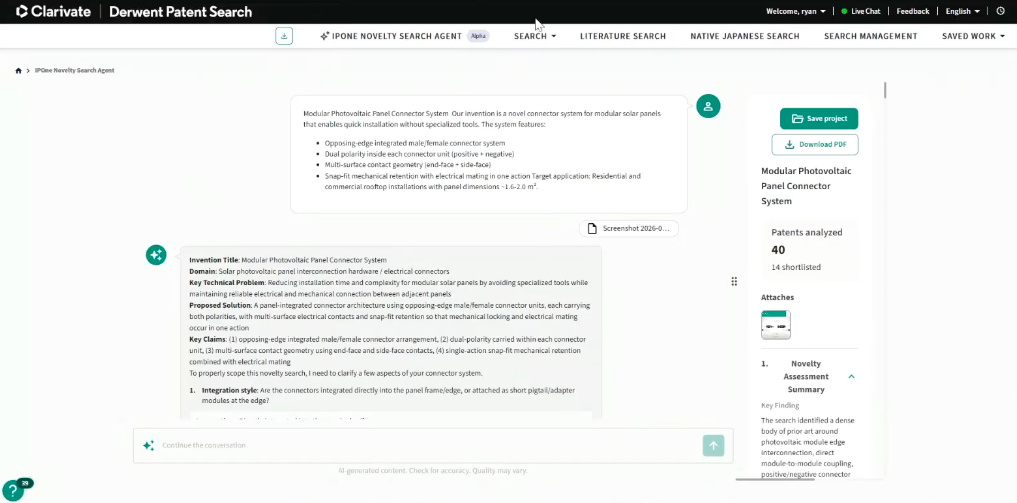
Clarivate Derwent combines patent searching with expert-enriched technical information.
Its Derwent World Patents Index (DWPI) provides expert-written invention summaries that explain technical disclosures using more consistent terminology.
This can help when you’re investigating older patents, unfamiliar technologies, or inventions described using different technical language.
Derwent also supports AI-assisted searching, citation analysis, and patent-family research.
Clarivate reports coverage of more than 178 million patent publications, alongside linked patent litigation information.
Key strengths:
- Expert-written invention summaries.
- Extensive historical patent information.
- AI-assisted technical searching.
- Citation, patent-family, and litigation data.
What to consider: Advanced research may require specialized expertise, and additional data products may require separate licenses.
Derwent’s main distinction is the quality and consistency of its enriched patent information. Check how its automation and collaboration features compare with your requirements.
- LexisNexis PatentSight+: Patent Portfolio Analytics
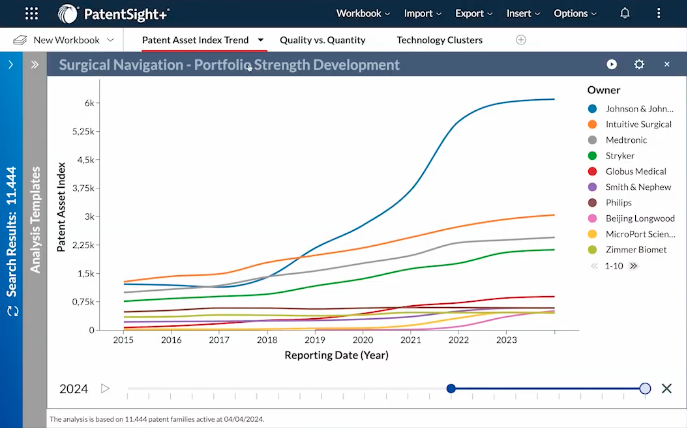
LexisNexis PatentSight+ focuses on understanding patent portfolio strength, ownership, and competitive position.
Its Patent Asset Index combines technological relevance and market coverage to support portfolio comparisons.
You can also investigate corporate ownership, including patents held by subsidiaries, acquired companies, and businesses operating under previous names.
That information can be useful during licensing negotiations, acquisitions, and IP due diligence.
PatentSight+ includes Protégé AI, which lets you ask natural-language questions about portfolios, competitors, and technology trends.
Key strengths:
- Patent portfolio benchmarking.
- Corporate ownership analysis.
- Patent Asset Index metrics.
- Protégé AI for conversational analytics.
What to consider: PatentSight+ focuses more on portfolio intelligence than detailed claim-level invalidity research. Confirm your access to Protégé and any additional data services.
Its analytical tools help you understand patent holdings and competitive positioning, particularly when assessing portfolio value or ownership.
- Patlytics: AI Patent Litigation and Analysis
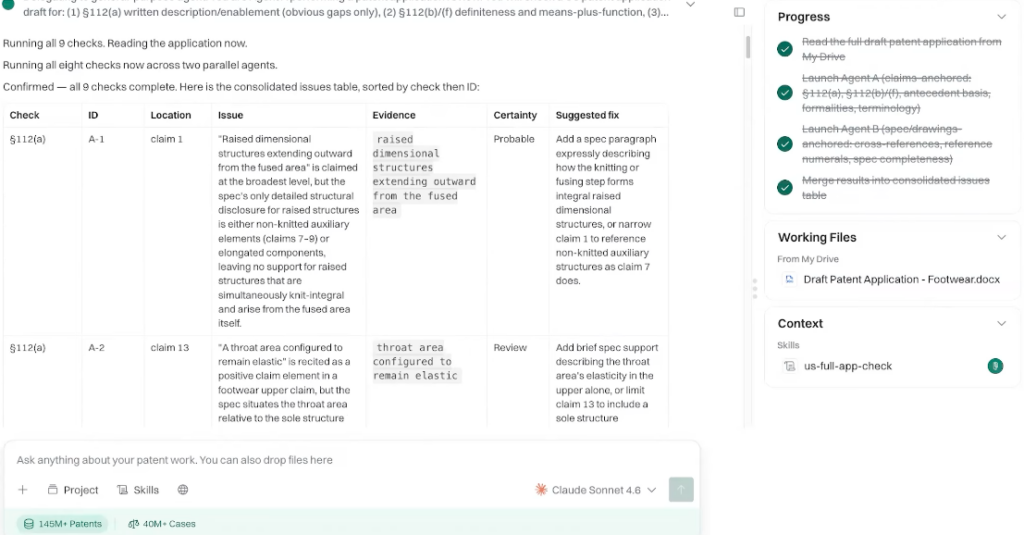
Patlytics focuses on the legal analysis that follows patent searching.
Its tools support infringement investigations, invalidity research, claim construction, and FTO analysis.
You can use AI-assisted claim charts to connect individual patent limitations with supporting technical evidence.
For example, when investigating invalidity, the platform can help identify earlier disclosures and map them against selected claims.
Patlytics also supports patent and non-patent literature searches, as well as AI-assisted legal research workflows.
Key strengths:
- AI claim charts and evidence organization.
- Invalidity and infringement analysis.
- Patent and non-patent literature research.
- Litigation-focused research workflows.
What to consider: AI-generated claim interpretations still require attorney verification. Its specialist functionality may also be unnecessary if your priorities are competitor monitoring or portfolio intelligence.
Patlytics focuses on organizing technical and legal evidence rather than providing a comprehensive patent intelligence platform.
What Should You Look for in Patent Intelligence Software?
Before comparing prices or AI features, consider how you’ll use the platform.
Can You Verify the Research?
AI-generated findings should link back to patent documents, claims, and relevant technical passages.
Check whether you can inspect the supporting evidence, understand how results were selected, and review important patent-family relationships and dates.
Does It Support Your Actual Workflows?
Think about what happens after you’ve found a relevant patent.
Do you need to prepare a legal analysis, monitor future filings, compare portfolios, or share findings with R&D?
A platform should support the work your team performs regularly, not just the initial search.
How Reliable Is the Data?
Check patent coverage, ownership records, legal-status information, and update frequency.
Database size alone doesn’t tell you whether the records are accurate or suitable for your research.
Can You Use It Securely?
If you’re handling confidential invention disclosures or client information, review the platform’s security and AI data-handling policies.
The Solicitors Regulation Authority has warned about inaccurate AI-generated material and risks to confidential client information.
You should understand where your data is processed, who can access it, and whether it’s used for model training.
What Does the Subscription Include?
Ask about AI features, user licenses, usage allowances, exports, integrations, and support.
A lower headline subscription may not represent better value if you need several additional products to complete your work.
How Responsive Is Customer Support?
Customer service is another important consideration, particularly when your team relies on patent intelligence software for time-sensitive research.
Ask prospective providers about onboarding, specialist training, technical support and typical response times. Can you reach someone who understands patent research? Is assistance available in your time zone?
Minesoft distinguishes itself through its customer success approach, offering dedicated support teams across multiple time zones and assistance in more than 15 languages. It also works closely with customers to incorporate feedback into product development.
When comparing platforms, consider not just the software’s capabilities but also how effectively the provider will support your team after purchase.
Which Patent Intelligence Platform Should You Choose?
Minesoft Origin is our best overall patent intelligence platform for IP teams in 2027, combining AI-assisted searching, custom classification, monitoring, and collaboration.
You can investigate patents, organize findings around your technology priorities, and share intelligence across legal, engineering, and R&D teams.
The alternatives offer capabilities worth evaluating, from detailed prior art searching and claim analysis to portfolio benchmarking and enriched patent data.
When choosing, focus on what happens after the search. Can you verify the evidence, monitor relevant developments, and turn findings into actionable information for your team?
For IP departments managing both individual investigations and ongoing intelligence, Minesoft Origin offers a strong combination of capabilities.