
As global uncertainty continues to reshape capital flows and client priorities, UHNW families are increasingly adopting multi-jurisdictional strategies that diversify not only investments but also domicile, talent and governance structures
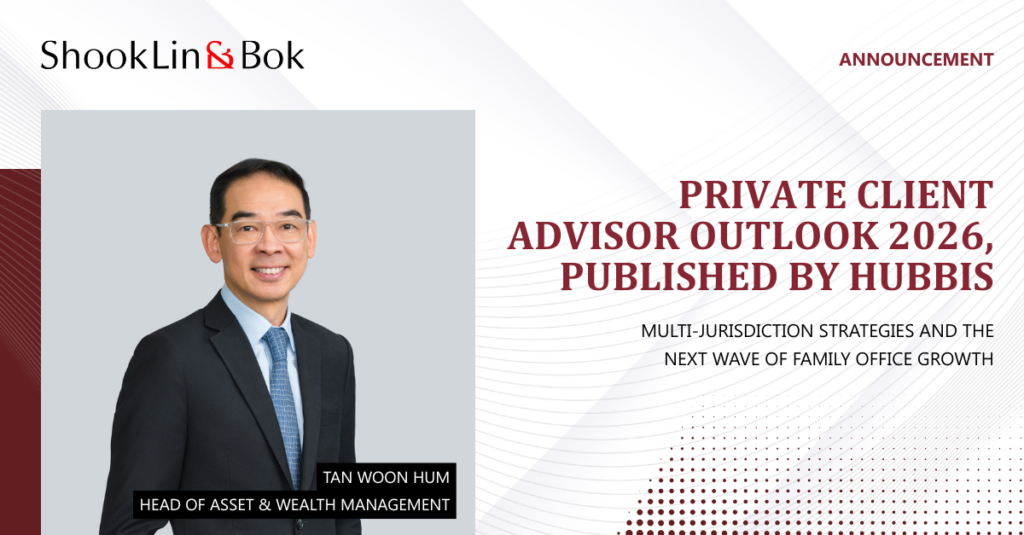
In his contribution to the Private Client Adviser Outlook 2026, Woon Hum Tan, Partner and Head of Asset & Wealth Management Practice at Shook Lin & Bok, examines how shifting migration patterns, evolving regulatory expectations and the maturation of the family office ecosystem are redefining long-term wealth planning. He highlights Singapore’s enduring appeal as a trusted financial hub, the growing complexity of cross-border structuring, and the rising demand for independent, conflict-free advice as sophisticated families reassess how and where to position their capital for resilience and future growth.
How do you expect global HNWI migration patterns to shift in 2026—who is leaving, who is arriving, and which jurisdictions (Australia, UK, Singapore, Dubai, others) are likely to see the most movement? What impact will this have on client structures, tax residency, and long-term planning?
As a consequence of continued and increasing global uncertainties, wars and threats of wars, we expect astute UHNWIs and large family offices to move capital and talent to jurisdictions that provide greater political-socio-economic stability, with strong rule of law and good connectivity. Whether driven by a flight to safety or the establishment of a parallel site and team, it has become a matter of survival rather than a luxury.
We anticipate that Singapore will remain a top choice, whilst Dubai might be considered favourably by the Europeans and South Asian clients. Hong Kong remains an attractive option ,particularly where investment opportunities or investors are predominantly from the PRC.
Structures that transcend borders will become more complex. Clients have to deal with multiple sets of laws and regulations, tax issues and reporting requirements. We expect more clients to take the plunge to bifurcate and create entirely new structures that seek to delink and de-risk from current structures. From a long-term planning perspective, segregating the pots of gold and stewards in times of volatility is a sensible and strategic approach. Clients have always preached diversification of investment risks by not putting all the eggs in one basket, they are now practising what they preached by diversifying the risks associated with capital and talent, by using two or more jurisdictions to house capital and talent.
Is the rapid expansion of family offices still accelerating, or are we now seeing the first signs of a plateau? What factors will determine whether new family offices continue to emerge or whether consolidation and professionalisation become the dominant themes?
The expansion of family offices slowed in the last two to three years, but we have observed clear improvement in inbound family offices over the last year. It is reassuring to see that the new entrants are larger in size and better in quality. They are drawn by Singapore’s value proposition, fully cognizant of what the regulators require. They appear to be better prepared, have better teams and have clearer long-term plans. While the landscape continues to evolve, we anticipate healthy growth with more of the right kind of family offices which will hopefully bring high calibre investment professionals, family office personnels and greater long-term value to Singapore.
There are successful single-family offices that have applied or are considering applying for the requisite Capital Markets Services licence to manage outside capital and assets. This development is understandable and a natural progression of family offices as they can scale, take on larger investment projects and get investors to share some of the operating costs. It is also a way to attract and retain talent. Some single-family offices choose to partner up with other single-family offices, or work with licensed multi-family offices. Such blueprints are adopted either as a first step to test the waters or by choice to avoid shouldering the entire operational burden and cost of running a single-family office alone.
Singapore has done a remarkable job (i) to remain an independent financial centre, and a top asset and wealth management hub, (ii) to maintain political-socio-economic stability, (iii) to have clear and business friendly laws and regulations, a clear rule of law, an independent judiciary, (iv) to maintain a strong ecosystem of professionals and service providers, and (v) to provide sensible and attractive tax incentives. If we continue to uphold these attributes, capital and talent will follow, supporting the healthy and sustained growth of the family office sector.
Singapore remains an open economy and I hope Singapore will continue to attract the right type of capital and talent. We have to be pragmatic and accept that it cannot be zero risk. Minister for National Development and Deputy Chairman of MAS, Mr Chee Hong Tat said it well at the Bank of Singapore’s 2026 outlook conference on 8 Jan. Minister Chee said “They choose Singapore because this is a place that can be trusted. This is a space that is stable, so we mustn’t lose that,” and “If we end up compromising on our trusted branding, we have more to lose. So I would rather preserve that – but don’t go for zero risk, because then you have no leeway to be able to innovate, to try new ideas.” (excerpt from a report in The Straits Times, published on 8 Jan 2026)
Which global hubs—Hong Kong, Singapore, Dubai, Switzerland, or emerging centres—are best positioned to “win” the next phase of family office growth, and what specific advantages or weaknesses will shape their competitiveness?
There may be no single, outright winner. The choice is not necessarily A or B but possibly A and B, or even A, B and C. It is about finding the most suitable jurisdiction(s) for that season, which could mean the most suitable place to house your capital and talent in the next phase of growth or to carry out the investment strategies. If the UHNWIs and the family offices believe that Asia is the safer option and the Asian emerging markets offer better investment returns in the next decade, then Singapore and Hong Kong would be the obvious choices.
We also need to distinguish between the booking centre and where the execution team sits. For instance, the UHNWIs and the family offices may book and keep substantial assets in Switzerland and Dubai, but the investment and execution take place in Asia. In this model, it is only logical from a strategic and long-term perspective to place the team in Singapore or Hong Kong. From a practical standpoint, consideration should also be given to where employees and their families prefer to live and work.
Has the regulatory burden in wealth management reached a point of over-correction, or is the current level of scrutiny appropriate for managing AML, tax transparency, and illicit finance risk? How is this affecting client behaviour, adviser bandwidth, and structuring decisions?
I believe the regulatory requirements have gone up one or two notches in recent years. It is justifiable and necessary as criminals, fraudsters and money-launderers become bolder and more creative. Our financial system is only as strong as our people, system, processes and risk culture. The correction in recent years is strong but I hope we do not go to the extreme end of the pendulum where idealistically zero risk is demanded. We must remain vigilant and work together to, as Minister Chee described, ensure that Singapore can continue to be trusted and stable, yet giving enough room for innovation.
We want innovative entrepreneurs and asset and wealth management professionals to make Singapore their home. We want professional advisers who are bold and creative in helping UHNWIs and the family offices with compliant structures and investments, working on cutting edge deals. Advisers must understand the laws and regulations and read the pulses of the regulators correctly, to be able to effectively advise the clients not only on the black letter law, but also the policy intent and expectations on the regulators.
Where do UHNW clients place the least trust today—private banks, trust companies, lawyers, accountants, tax advisers—and why? What does this reveal about adviser credibility, industry behaviour, and the shifting expectations of sophisticated families?
Many UHNW clients are educated, sophisticated, experienced and successful. They may have an entourage of smart people working for them and advising them. It would not be surprising if some of these clients know more than the bankers and advisers who serve them. As such, they cannot be sold products that they neither want nor need, nor persuaded by an investment thesis that is less stable or less compelling as those sitting in their existing portfolios. If the advisers have little or no conflicts of interest, are truly independent, can bring the clients genuine value, they will win the trusts of the clients.
Clients want advisers, not product pushers. In my years of experience dealing with UHNW clients, I strongly believe that trust is built only when demonstrating a sincere commitment to safeguarding not only their interests, but also the well-being of their families.
Click here to read the full article.

For further information, please contact:
Tan Woon Hum, Partner, ShookLin & Bok
woonhum.tan@shooklin.com