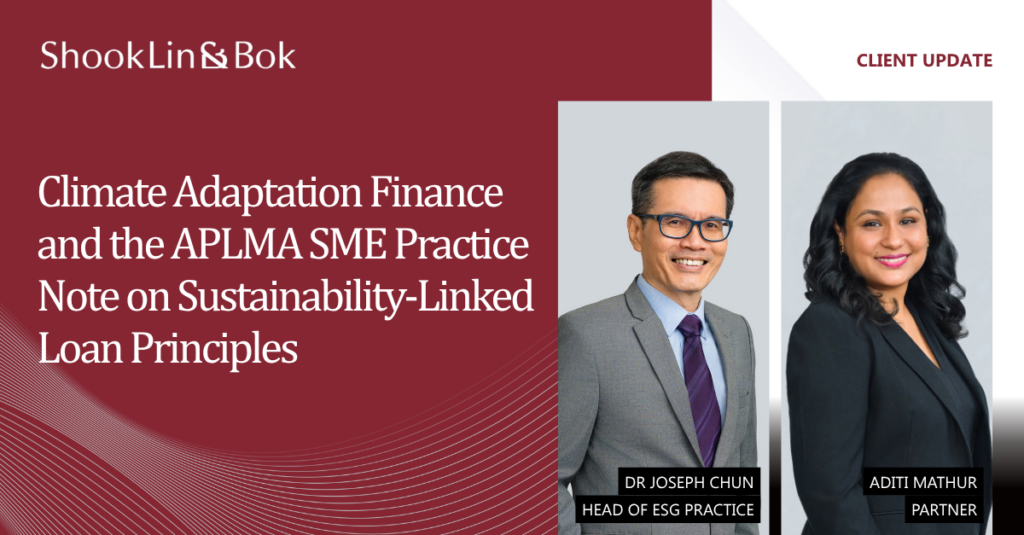
Our Head of ESG, Dr Joseph Chun, together with Partner Aditi Mathur, discuss how the SME Practice Note on Sustainability-linked Loan Principles (SLLP) can provide a practical pathway for SMEs seeking climate adaptation financing.
The Asia Pacific Loan Market Association (“APLMA”) recently launched its SME Practice Note on Sustainability-linked Loan Principles (“SLLP”) to provide guidance to small and medium enterprises (“SMEs”) on the application of the SLLP in a practical, simplified, and scalable way that maintains its integrity while considering the realities of smaller businesses. This client update explains how the Practice Note may offer a way forward to SMEs seeking climate adaptation finance.
1. Introduction: The Inevitability of Climate Adaptation
For years, global climate finance and corporate sustainability initiatives have focussed heavily on mitigation. However, as global emissions continue to rise, leaving the world significantly off track from its Paris Agreement targets, the reality is now undeniable: the physical impacts of climate change, such as rising temperatures, rising sea levels, and volatile weather patterns, are already locked in and intensifying.
SMEs in Singapore and the broader Southeast Asian region are particularly vulnerable to the physical climate disruptions which pose an immediate threat to supply chains, asset values, and operational continuity. Relying solely on mitigation is no longer a viable risk-management strategy; adjustments in processes, practices, and structures to moderate potential damage or benefit from opportunities associated with climate change, is an operational inevitability.
Adaptation Under the Singapore-Asia Taxonomy
The Singapore-Asia Taxonomy for Sustainable Finance (“Taxonomy”) formally establishes adaptation as one of its five core environmental objectives. Recognising that adaptation measures respond to physical risks that are mostly location and context specific, the Taxonomy approaches adaptation as a set of guiding principles, which can be applied in any sector:
- Principle 1: The economic activity implements measures to increase own resilience;
- Principle 2: The economic activity enables other economic activities to adapt to climate change.
- Additionally, the economic activity should not adversely affect adaptation efforts by others, or increase the physical risks posed to others. Adaptation solutions must also not cause significant harm to other environmental objectives.
2. The Structural Barriers of Use-of-Proceeds Green Loans for Adaptation
Focusing on Principle 1 of the Taxonomy approach to adaptation, use-of-proceeds (“UoP”) green loans may be difficult to secure for measures to increase own resilience, particularly for SMEs, due to several structural and practical barriers:
- Restrictions on UoP: UoP loans require all of the loan proceeds to be exclusively earmarked and tracked for specific, ring-fenced ‘eligible green projects’. SMEs may require more flexible, multi-purpose working capital facilities to manage day-to-day operations alongside sustainability upgrades.
- Intangible Adaptation Benefits: Green loans traditionally rely on easily quantifiable “green” metrics. Adaptation investments, by contrast, are often defensive and qualitative. Because the “benefit” is an avoided future loss, fitting these initiatives into rigid UoP loan frameworks for climate mitigation, which typically generates direct cash flows to service loan debt, is less straightforward.
- Unclear Taxonomies: Unlike mitigation, for which green taxonomies and markets standards provide universally accepted technical screening criteria, there is less guidance on what qualifies as legitimate adaptation.
- High Transaction and Verification Costs: The legal, advisory, and reporting overhead required to maintain a certified green loan can easily outweigh the interest-rate discount provided by the bank.
Why Sustainability-Linked Loans (“SLLs”) May Suit Adaptation Financing Better
Given these frictions, SLLs may offer a more attractive alternative for financing adaptation plans.
Unlike UoP loans, SLLs are fundamentally general corporate purpose facilities. The loan proceeds can be used flexibly across the business. Instead of tracking where the money goes, the loan’s financial terms are tied to whether the borrower meets pre-determined, forward-looking Key Performance Indicators (“KPIs”) and Sustainability Performance Targets (“SPTs”).
For adaptation financing, SLLs may be more suitable because they allow SMEs to secure a flexible credit line while committing to holistic resilience metrics over the life of the loan. Rather than funding a single adaptation project, SLLs can incentivise SMEs to reduce its overall climate vulnerability score or secure climate-resilience certifications across its entire operation.
3. Leveraging the Practice Note for Adaptation
The Practice Note may further enhance the appeal of SLLs for adaptation. It introduces practical flexibilities and scalable good practices specifically tailored to the resource constraints of SMEs, facilitating greater access by SMEs to adaptation-focused SLLs.
A. Selection of KPIs
The Practice Note recognised that while the SLLP requires borrowers to select KPIs that are material to and consistent with the borrower’s overall sustainability and business strategy; address relevant ESG challenges of its industry sector; and are measurable, quantifiable, and benchmarkable, SMEs may face hurdles in meeting these requirements because they often lack the foundational elements needed to identify or measure such KPIs.
Thus, although lenders should still ensure that these KPIs are only selected where they are at least material to the borrower’s own business operations, they may suggest KPIs that are relatively easy to understand, measure, and verify, and therefore can serve as initial entry points into SLL structures.
In our view, adaption-related KPIs could potentially include:
- percentage of raw materials sourced from climate-diversified regions or climate-resilient suppliers;
- percentage reduction in daily water consumption per unit of production, or capacity of installed rainwater harvesting/greywater recycling systems;
- percentage of facility energy demand supported by climate-resilient decentralized energy systems;
- percentage of physical assets and inventory covered by climate risk insurance;
- number of heat-stress or extreme-weather safety training hours completed by employees; and
- revenue generated from climate adaptation-related products or services.
B. Simplified Benchmarking for SPTs
The Practice Note also recognised that as many SMEs may not yet have a formal sustainability strategy or defined long-term sustainability roadmap, lenders may find it difficult to assess whether proposed SPTs are ambitious based on borrowers’ material improvement beyond a Business-as-Usual (“BAU”) trajectory, and consistency with their overall sustainability strategy.
Where historical data or peer benchmarks are limited, a practical and context-sensitive way to gauge ambition for SMEs may be to consider the scale of capital expenditure (“CAPEX”) or additional investments the SME would need to undertake (vs. annual expenditure in a BAU scenario) to achieve the targeted performance levels.
C. Proportionate and Cost-Effective Reporting and Verification
The Practice Note made further observations on reporting and verification:
- For SMEs in particular, where data availability or resource constraints may make annual reporting challenging, aligning the reporting frequency with the actual SPT timeline (be it annually or once every 18 months, as long as such frequency is mutually agreed between the lender and the SME borrower) can be a pragmatic solution, while still ensuring transparency at each point where performance is assessed.
- Lenders may consider waiving the external verification requirement on a case‑by‑case basis, particularly where the KPI data originates from independent and reliable third‑party sources and where the lender has conducted a robust assessment of the data source and data preparation process. There may be other circumstances in which the lender and the borrower reasonably conclude that annual third‑party verification provides limited incremental value in relation to the sustainability goals under the SLL, as long as any waiver is clearly justified, documented, and aligned with the overarching intent of maintaining trust and transparency in the SLL engagement between the lender and the borrower.
4. Conclusion and Strategic Next Steps for SMEs
Adaptation is no longer an optional corporate social responsibility milestone; it is now a baseline requirement for business survival in the Southeast Asian region. While UoP green loans may remain too rigid and administrative for most smaller enterprises, a flexible approach to SLLs may provide a path forward.
SMEs may want to approach their banks for assistance in identifying their immediate physical climate risks and mapping out the necessary capital upgrades and appropriate timelines, and to discuss how to utilise the flexibilities offered by the Practice Note to structure for a general corporate purpose SLL to finance their adaptation CAPEX Plan.
Our Corporate Banking team also stands ready to render advice tailored to specific SLL arrangements, or for assistance in drafting facility agreements aligned with the Practice Note. We are one of Enterprise Singapore’s appointed partners for the Sustainability Legal Catalyst Programme, which offers financial support in accessing expert legal guidance on sustainable finance amongst other things. Business entities registered or incorporated in Singapore, with a minimum of 30% ultimate individual ownership by Singapore citizens or permanent residents, can obtain a defrayal of up to 50% in legal fees, subject to a cap of S$90,000 per company.
This Client Update was authored by Partners Dr Joseph Chun and Aditi Mathur. Should you have any queries on this update or generally, please feel free to contact them.
Click here to read the article in PDF.