

Singapore’s Barbell Economy: How One Data-Center Giant and 277 Startups Are Rewriting the Rules of Southeast Asian Venture Capital
Singapore’s venture market split into two games in the first half of 2026. Only one of them still looks like venture capital.
Based on Morningstar data* analysed by Conventus Law, In the first half of 2026, Singapore’s venture landscape produced one of the starkest illustrations yet of an industry splitting into two entirely different games. On one end sat 277 startups, software builders, biotech researchers, fintech operators, raising anywhere from $50,000 to $10 million to prove a concept or scale a niche. On the other sat a single company, DayOne Data Centers, which in June closed a $4.5 billion Series C round led by existing investors Coatue and Hillhouse, now DayOne’s two largest shareholders, with participation from new investors including the Indonesia Investment Authority and Achi Capital Partners. That one transaction, confirmed by multiple independent reports of the closing, dwarfs the combined disclosed value of the other 277 fundraises tracked for Singapore-headquartered startups over the period. Together, the 278 deals offer a rare, granular window into how capital is actually moving through the city-state’s startup ecosystem, and how thin the legal and regulatory scaffolding underneath it has to stretch to support both ends of that spectrum at once.
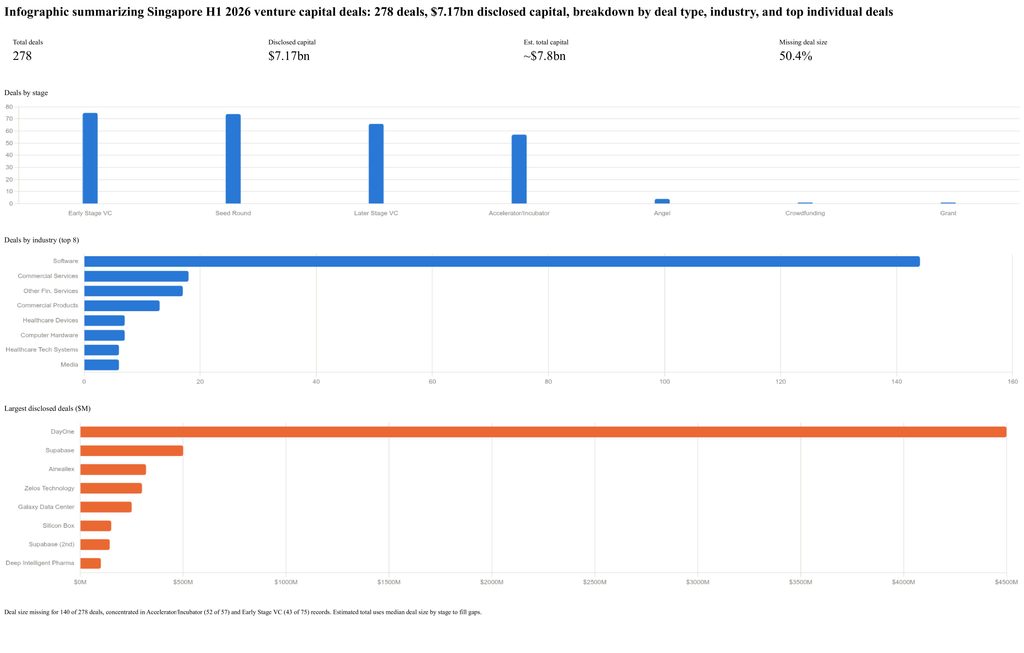
The numbers tell a story of concentration. Of the 278 recorded transactions, only 138 disclosed a specific deal size, and among those, the sum totals $7,165.77 million. Strip out DayOne’s outsized contribution and the remaining 137 disclosed deals amount to roughly $2,665.77 million, meaning one transaction alone accounted for well over 60% of all known capital deployed into Singapore-based companies in the first half of the year. The next-largest disclosed rounds, Supabase’s later-stage raises of $500 million and $143.1 million, and Airwallex’s $320 million round, are themselves substantial by regional standards, yet collectively still represent a fraction of DayOne’s single close.
That tail, however, is where the real ecosystem building is happening, and where Singapore’s regulatory architecture has been most deliberately engineered to lower friction. Software dominated deal volume, 144 of the 278 transactions, or 52%, but at a completely different scale than DayOne’s infrastructure play, with a median deal size across all early-stage and seed transactions sitting in the low single-digit millions. Seed Rounds (74 deals) and Early Stage VC (75 deals) together accounted for well over half of all recorded activity, alongside 57 Accelerator/Incubator transactions that typically involve nominal capital but signal formation-stage momentum. This is precisely the segment the Monetary Authority of Singapore has spent the better part of a decade trying to cultivate through its Venture Capital Fund Manager, or VCFM regime, a deliberately lighter licensing track under the Securities and Futures Act that exempts qualifying VC managers from the base capital, independent valuation, and audited financial statement requirements imposed on conventional fund managers, in recognition of the illiquid, long-horizon nature of venture investing.
The regime has proven durable precisely because it keeps evolving rather than sitting still. MAS revised its licensing and conduct of business guidelines to tighten personnel requirements for VCFMs, moving from a bare minimum of two Singapore-resident directors to a more demanding standard requiring a full-time, Singapore-resident CEO responsible for daily operations, at least one executive director, and two full-time resident professionals, a signal that regulators are willing to raise the bar on governance even as they keep the overall compliance burden lighter than for licensed fund management companies. That balance matters enormously to a set of deals like this one, where dozens of accelerator-stage and seed-stage vehicles are almost certainly operating under exactly this streamlined authorization, alongside the institutional-grade managers capable of underwriting a DayOne-scale check.
Structurally, the Variable Capital Company has become the vehicle of choice for housing these funds, with well over a thousand VCCs now incorporated in Singapore and increasingly serving venture, private equity, and family-office capital alike. Its appeal lies in flexibility that the ordinary Companies Act framework doesn’t offer: umbrella structures that ring fence multiple fund vintages under a single administrative shell, distributions payable out of capital to accommodate illiquid startup equity, and a tax treatment, under Sections 13O and 13U of the Income Tax Act, designed to make Singapore cost-competitive against Cayman or Delaware fund domiciliation. Every VCC still requires a “Permissible Fund Manager” regulated by MAS, which is precisely the linkage tying the VCC’s flexibility back to the VCFM licensing track and its recent governance tightening.
There’s a policy signal embedded in the government’s own recent moves that speaks directly to the DayOne sized end of this dataset. At Budget 2026, the Prime Minister, Lawrence Wong, announced the formation of a Growth Capital Workgroup, chaired by Chee Hong Tat, Minister for National Development and Deputy Chairman of the Monetary Authority of Singapore, tasked specifically with strengthening Singapore’s position as a hub for later-stage, large-ticket growth capital, the exact category DayOne’s round exemplifies. That initiative reads as an acknowledgment that Singapore’s seed and accelerator engine, visible in this dataset’s dozens of sub-$1 million transactions, has matured enough that policymakers are now turning attention to the harder problem of retaining and financing companies once they outgrow venture-scale checks and start needing growth-equity and pre-IPO capital instead. DayOne’s own trajectory, a 2022 spinout from China’s GDS Holdings, a rebrand in 2025, and now a planned Nasdaq/Singapore dual listing at a reported $20 billion valuation, is close to a case study for exactly the kind of late-stage, cross-border capital formation the Workgroup was created to support, complete with the geopolitical sensitivities that come from housing a Chinese-origin infrastructure platform inside a Singapore corporate wrapper ahead of a U.S. listing.
The dataset’s limitations, though, temper how confidently any of this can be quantified. Deal Size is missing for 140 of the 278 recorded transactions, 50.4% of the total, concentrated heavily among Accelerator/Incubator deals (52 of 57 lack a disclosed figure) and Early Stage VC rounds (43 of 75), meaning the true scale of capital flowing into Singapore’s earliest-stage companies is substantially understated by the raw $7.17 billion figure. Twenty records also lack investor information entirely, limiting any attempt to map syndicate networks with full confidence, though Antler, Sky9 Capital, and government-linked SEEDS Capital emerge as the most frequent participants among disclosed deals.
Given the missing-data, a reasonable estimated projection using the median disclosed deal size within each deal-type category to extrapolate values for the 140 missing entries, a method chosen specifically to avoid distortion from the DayOne and Supabase outliers, would add approximately $629 million to the known total: roughly $430 million across the 43 undisclosed Early Stage VC deals (median $10 million each), $160 million across 25 undisclosed Later Stage VC deals (median $6.4 million), $25.5 million across 17 undisclosed Seed Rounds (median $1.5 million), and smaller contributions from Accelerator and Angel categories. That would bring estimated total H1 2026 capital deployed into Singapore-based companies to roughly $7.8 billion, a figure that should be read as a statistical extrapolation, not a factual finding, and one entirely dependent on the assumption that missing deals resemble the median of their disclosed peers rather than skewing toward either extreme.
What the dataset ultimately captures, gaps and all, is a venture ecosystem operating on two clocks simultaneously: a fast, high-volume cycle of seed and early-stage software bets moving through a regulatory pipeline MAS has spent years simplifying, and a slow, infrequent cycle of infrastructure-scale growth capital that increasingly resembles project finance more than venture investing. Singapore’s policy apparatus, from the VCFM licensing track to the VCC structure to the newly formed Growth Capital Workgroup, is now visibly trying to serve both clocks at once. Whether it can do so without distorting the other, particularly as AI infrastructure deals of DayOne’s magnitude become less anomalous and more routine, is likely to be the defining regulatory question for Singapore’s capital markets through the remainder of 2026.
*The Morningstar data obtained had a high rate undisclosed financial information, including missing deal sizes, valuations and demographic data. The absence of this data limits the ability to calculate the true total market capitalisation and a granular analysis of valuation trends.
