
The legal landscape surrounding civilian ownership of protective equipment is more nuanced than many assume. Across the United States, rules vary significantly by state, and the consequences of non-compliance can include felony charges.
This article provides a structured legal overview of body armor regulations at the federal and state level, covering who can own it, where it can be worn, and what restrictions apply to businesses that sell it.
Federal Law: The Baseline Standard
At the federal level, body armor ownership is governed by 18 U.S.C. Section 931. This statute prohibits any person convicted of a violent felony from purchasing, owning, or possessing body armor.
A ‘crime of violence’ under this provision refers to any felony involving the use, attempted use, or threat of physical force against a person or property. Violations carry a sentence of up to three years in federal prison.
Outside of this prohibition, federal law imposes no general restriction on civilian ownership. Law-abiding adults aged 18 and over may purchase and wear body armor without a background check or permit in most jurisdictions.
State-by-State Restrictions
While federal law sets a minimum standard, individual states have enacted significantly stricter rules. Legal professionals and compliance teams should note that these laws are actively evolving.
Most Restrictive States
New York imposes the tightest civilian restrictions in the country. Civilians may only purchase body armor if they are employed in an approved profession, such as law enforcement or licensed security. Purchases must be made in person.
Connecticut bans online and remote sales entirely. All body armor transactions must be completed face-to-face. This requirement applies to retailers and individual sellers alike.
California’s Assembly Bill 92 (effective January 2024) extended the prohibition to anyone barred from firearm ownership, including those with certain domestic violence records. Retailers must conduct background checks before completing a sale.
States With Targeted Restrictions
Maryland requires individuals with prior convictions for violent crimes or drug trafficking to obtain a five-year permit before purchasing body armor.
Louisiana prohibits wearing body armor on school property, at school-sponsored events, or on school buses, with exceptions for authorized personnel such as law enforcement officers.
Illinois makes it a separate offense to wear body armor while in possession of a dangerous weapon, regardless of whether a crime is being committed.
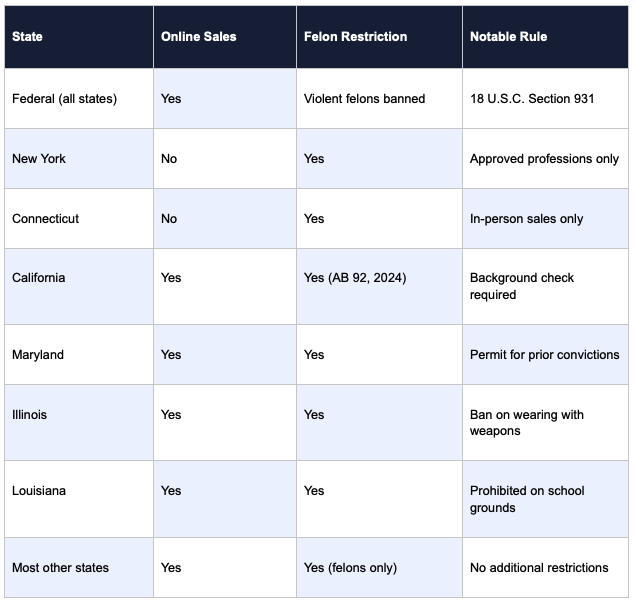
State Law Comparison Table
The table below summarizes key body armor regulations across selected US states:
Legal Risks: Where Body Armor Cannot Be Worn
Ownership rights do not translate to unrestricted use. Even in states where civilian possession is broadly permitted, certain locations carry specific prohibitions.
- Courthouses and government buildings
- School premises and school-sponsored events
- Firearm-free zones in states with such designations
- Any location where wearing armor during a crime triggers enhanced sentencing
Wearing body armor while committing or attempting to commit a crime is treated as a separate offense in most jurisdictions. Penalties often include an additional felony charge or mandatory sentence enhancements on top of the underlying offense.
Compliance Considerations for Retailers and Sellers
Verification Obligations
Retailers are not passive actors in this regulatory framework. In states like New Jersey and California, sellers are legally required to verify that a buyer is not a prohibited person before completing a transaction.
Online retailers face particular complexity when shipping across state lines. A sale that is lawful in the seller’s state may be prohibited by the buyer’s state laws, particularly regarding online purchases in Connecticut and New York.
Export Restrictions
Federal law prohibits exporting body armor outside the United States without prior authorization from the relevant federal agency. This restriction applies regardless of the destination country’s domestic laws.
Expert Commentary
Legal commentary from criminal defense practitioners consistently notes that the most common compliance failure occurs when buyers in restricted states attempt to purchase online without verifying their state’s in-person transaction requirements.
According to published guidance from CriminalDefenseLawyer.com, state and federal laws in this area are ‘constantly changing,’ and attorneys recommend that buyers verify their state’s current statutes directly before any purchase.
Video Overview: Understanding Body Armor Laws
The following video provides a useful reference on civilian body armor laws and regulatory compliance in the US:
[YOUTUBE VIDEO] https://www.youtube.com/watch?v=3LzxSc0hVSI
Choosing Legally Compliant Equipment
For those who are legally eligible to own protective equipment, selecting a reputable manufacturer matters for compliance purposes. Products certified under NIJ (National Institute of Justice) standards are the most commonly accepted reference point in both state and federal regulatory contexts. Civilians and security professionals often turn to established suppliers of certified body armor to ensure their equipment meets the applicable standards for their jurisdiction.
Frequently Asked Questions
Is body armor legal for civilians in all US states?
No. While federal law permits ownership for non-felons, states like New York restrict purchases to approved professions. Connecticut requires all sales to be made in person. Buyers must check their state’s current statutes before purchasing.
Can a convicted felon ever legally possess body armor?
Federal law prohibits violent felons from owning body armor. Some states extend this prohibition further to include non-violent felony convictions. A narrow exception exists under federal law if an employer provides written certification that the armor is necessary for the employee’s lawful work.
Do retailers face legal liability for selling to prohibited persons?
Yes, in several states. California and New Jersey require sellers to verify buyer eligibility before completing a transaction. Failure to do so can expose retailers to civil and criminal liability.
Can body armor be exported from the United States?
No, not without federal authorization. Exporting body armor without the required federal clearance is a violation of US export control law, regardless of the receiving country’s regulations.
Does wearing body armor while committing a crime result in additional charges?
Yes. In most states and under federal law, wearing body armor during the commission of a crime results in a separate charge or sentencing enhancement. This applies even if the underlying offense is not completed.
Key Takeaways for Legal Practitioners
- Federal law under 18 U.S.C. Section 931 applies nationwide and prohibits violent felons from owning body armor
- State laws vary widely; New York and Connecticut are the most restrictive
- Retailers in multiple states carry affirmative verification obligations
- Wearing body armor during a crime carries penalties separate from the underlying offense
- Export of body armor outside the US requires federal authorization
For further regulatory and compliance analysis published on Conventus Law, see our coverage on Regulatory and Compliance and related topics in Criminal Law.