Author: Patrick M Dransfield
“Everything that happens is determined by what came before and is connected to what follows.”
George Forster (1754 – 1794, botanist and explorer).
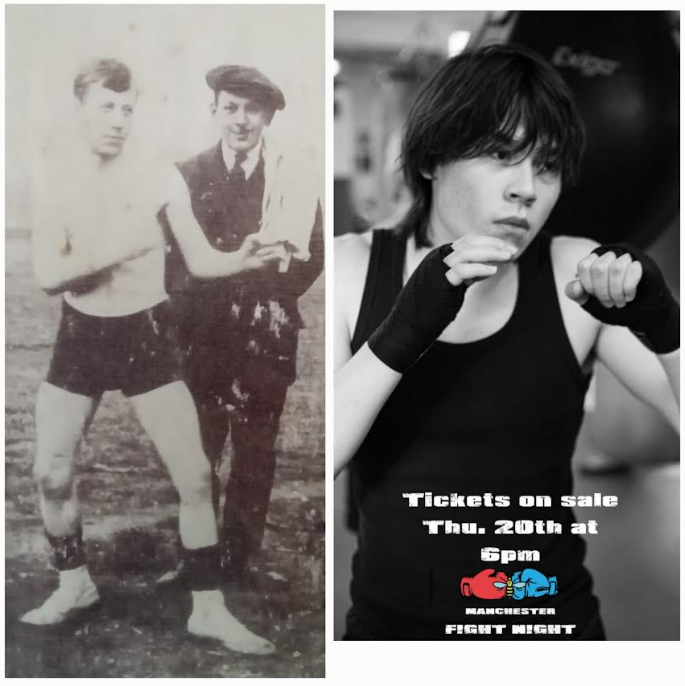
My grandfather Joseph Dransfield was a factory worker, labouring in a Huddersfield mill as a cloth finisher. My father Philip Dransfield told me this was an artisan’s job and required intelligence, judgment and skill. I only have very dim memories of my grandfather – a gentle soul with blue, rheumy eyes – but every time I look at the smooth, green cloth covering a full length snooker table, I think of him. Joseph, along with his brother-in-law, Willy, also bred chickens and rabbits and grew potatoes, broad beans, tobacco and kept bees on the allotment the family rented which abutted the row of south-facing workers’ terraced houses called ‘Sunnybank’, high up in the Pennines. In whatever spare time the young Joseph had left after working and his family chores he dedicated to amateur boxing. Being small, he was classified as a flyweight. Being deaf, he avoided being called up for the First World War, which took account of his three elder brothers’ lives. Joseph Dransfield is on the left, alongside a picture taken recently of his great grandson, Jacob Dransfield, our youngest child.
Joseph’s father and his father before him were quarry men, carving out the Millstone Grit from the quarry above South Crosland moor with his brothers: hewing out the hard rock and then chiseling the dressed stones that went into the handsome mansions and semi-detached houses that were popping up in towns such as Halifax and Huddersfield. Wealth generated by the woollen mills came to Victorian Yorkshire’s West Riding and is evident in the excellent homes still left today, now cleaned up to a honey hue as the black soot of the factories and mills no longer pollutes the valleys.
My great uncle Willy Armitage, brother to my father’s mother Edith Dransfield (née Armitage) was born around 1894. Between ten to fourteen he was called a ‘half-timer’. Being a ‘half-timer’ was an improvement as previous generations of Armitage boys had no access to education: it meant that by the age of fourteen Willy had spent half his time in public education and the other half working. Willy probably started his long working life by collecting the shoddy, remnants of old wool clothes, from the floor beneath the large textile looms in one of Huddersfield’s numerous wool mills.
By all accounts, the Armitage clan were a sober lot, having signed the temperance pledge. William Armitage, a great, great grandfather to Jacob, was a Chartist and joined the Colne Valley workers on their march to London on April 10th, 1848. The Chartists knew precisely what they were being denied as human beings by their industrial bosses and the London-dominated political classes. These deprivations included not having the opportunity to vote, no voice regarding the scandalous treatment of their children who were working in dangerous conditions in the mills and factories, and the denial of access to even a basic education. Due in large part to their agency, which included three major Chartist marches on London in the mid nineteenth century, conditions began to change for the better. Firstly came the passing of a series of landmark Factory Acts and Education Acts (e.g. the Factory and Workshop Act of 1878), culminating in the granting of women’s right to vote in the United Kingdom in 1918.
No doubt the majority of textile mill owners in the West Riding and Lancashire during the 1830s and 40s thought of the Industrial Revolution as a natural and irresistible force over which they, while enriched by it, had no agency: the momentum of maximum profits taking all before it . If the good burghers of the West Riding and Manchester were familiar with the word, they would have described Capitalism as ‘a tsunami’ that through a natural force dictated that children as young as eight (not their children, mind) were required to risk their limbs and even their lives on the factory floor. They no doubt thought and spoke in just the same way that today’s ‘tech bro’ Elon Musk, describes artificial intelligence and robotics as a “supersonic tsunami”. Back then, in the dark, satanic mills of Victorian England, according to Sarah O’Conner, author of ‘We are not Machines’ , a society no less bewildered and disorientated by the pace of change as ours, was able to stir itself eventually to protect its young and protect and educate the majority of its citizens. So must we. The stakes are after all existential. Opinion is divided as to when; however, we are approaching ‘AI singularity’, a tipping point when artificial intelligence surpasses human capabilities, triggering a runaway cycle of self-improvement and accelerating technological growth. The possible endgames put forward by serious observers range from a productivity utopia to the annihilation of humanity.
Among the tiny minority of ‘tech bro’ cousins in Silicon Valley who see themselves as masters of the universe there are those that see us as ‘median people’, an underclass – a class of ‘non-player actors’ – about to get screwed. But, as my ancestors in West Yorkshire clearly perceived, technological advancement is not the same as human progress. The current development of AI is an existential force and certainly does have the potential to change everything. Just in the past six months the capabilities of Anthropic’s latest Mythos AI model so spooked the White House that it is now discussing AI regulation. Nuclear weapons, that other great existential threat dangling above humanity, have thus far been controlled by the governments of countries and nation states. This is clearly not the case regarding the current development of AI in the West. It is not just about the money – but the money at stake is huge, with over US$2 trillion invested in AI development globally in the past five years. In the west, AI’s development lies in the hands of a tiny minority of private individuals. And a cursory look at the transcripts of statements and emails between Sam Altman, CEO of OpenAI, and his adversary Elon Musk, during their recent public litigation in Oakland, California, provides absolutely no comfort regarding the mindfulness or maturity of these two ‘masters of the universe’: in my opinion, two adolescent males scrapping in the street would be more self-aware and coherent than these two billionaires.
It is clearly not a character trait of such folk in Silicon Valley to reflect on past history (Peter Thiel being rather an eccentric ‘outlier’ exception), or even on the deeper meaning of concepts such as Language and Ethics. It is therefore important for the majority of us to reflect on what is happening with the AI revolution in the wider context of human history and machines and visit again that quote that leads this article –“Everything that happens is determined by what came before and is connected to what follows.” Our antecedents faced what appeared to be irresistible threats in the forms of disease, social change and technological advancement from the great plagues of the thirteenth, fourteenth and fifteenth centuries; through the Enclosure Acts of the seventeenth and eighteenth centuries, resulting in the unfair redistribution of common land to the gentry; the breaking up of local home-spinning to forced employment in town-based factories, unsuccessfully resisted by the Luddites, to the present day and the coming of AI Singularity.
It is most unfortunate that we face this AI revolution at a time when Human Wisdom in the west is at a nadir. To quote Marilynne Robinson, author and theologian: “I believe we have lost true freedom of thought in America, not because of special interests or conspiracies but because of a diminishment and slacking off that makes us vulnerable…. Essentially, America has become lazy and graceless. This atrophy has only worsened with the worship of technology, with AI its nadir.
“There’s an attempt, zealously carried forward (by the present Trump administration) to make people feel the same antagonism to the stranger that has disgraced many civilizations before ours.”
Marilynne Robinson sees the solution through a return to considered religious devotion and an embrace of Language as a beacon of beauty. As the majority of the AI models currently available are Large Language Models (LLMs) it would be a good moment to pause a moment and actually reflect on that word ‘Language’ – to define it. I now draw upon the wisdom of one of the great literary giants of the twentieth century, the late F R Leavis (1895 -1978): “Language is not just an instrument of expression. Its users inherit it but also develop it; and, like literature and criticism, it is the means of articulating a personal view which aspires to be more personal, to communicate within the human world by means of collaboration between speaker and hearer.”
The prescient Leavis noted the following in 1975: “Despite the belief of some that “this is the age when a computer can write a poem”, Leavis asserts that meaning is an exclusively human activity – and “language apart from meaning is not language”.” (From Introduction to ‘The Living Principle’ by F R Leavis by Paul Dean).
The late Kirtee Kapoor (1971 – 2017), outstanding corporate lawyer, partner at the Hong Kong office of Davis Polk, and friend, defined a legal contract to me in a decidedly Leavisian manner: “A business contract between two parties is the encapsulation of a dialogue in which what has been agreed by the two parties is set out cogently and coherently and in a manner and language appropriate to a legal document”.
In the Leavisian / Kapoorian world, a human being is essential to meaningful language and is not just some overseer of an AI generated ‘Poem’ or ‘Legal Contract’. Human beings are essential to both a successful poem and a binding legal document. Language evolves through human usage and is not a frozen relic to be mined through mindless machine data trawls.
So, what is to be done? Fortunately, there are still some wise voices in positions of influence alert to the evolving potential human catastrophe. They include Pope Leo XIV who recently published his encyclical Magnifica Humanitas. In this landmark document, Pope Leo reminds us that while AI may surpass human intelligence, AI and human intelligence are not the same thing. AIs “do not know from within what love, work, friendship or responsibility mean”. Machine learning does not imply inner growth. An AI-generated legal document is not the summation of a human dialogue. He warns in particular against so-called post- or transhumanist views because these attempts to improve humanity see human limitations as flaws to get rid of. Pope Leo argues that AI must be disarmed and reframed to serve human dignity rather than concentrating wealth, military power and data into the hands of a few tech leaders.
In my own view, rather the holistic interconnected vision of humanity and the universe of George Forster, Confucius and Heraclitus than the binomial nomenclature of Carl Linnaeus. I agree with the the recent Editorial Opinion expressed in the Financial Times: “So one can envisage permissive legal forms (of AI) if accountability is assumed by morally mature individuals, companies and governments.” President Trump’s response thus far is hardly encouraging, appealing as ever to the worst elements of American debate by polarising the issue and reframing it as a political struggle between the right and ‘the radical left’. No moral leadership or even imagination there; just his usual manipulation and infatuation with power and greed. “But it is incumbent on us as individuals and collective cultures to retain our own judgment of how our society fares, and avoid the path of least resistance that leave uncertainty to be managed by machines.” (Financial Times, 6 June).
It will prove difficult to build a path that assists technology in its beneficial advancement, but assumes effective guardrails for humanity. But it behoves each individual to voice their views and also support international governing bodies such as the United Nations and UNESCO which argue for international treaties, safety standards and cross-border oversight regarding the development of AI. Our own and our children’s future depends on it.
Patrick M Dransfield MA, BA (Joint Hons)
Author and Photographer, is the Principal of Clearway Communications:
https://www.clearwaycomms.com/