
Capital Flight and Regulatory Fortresses: Dissecting India’s H1 Venture Capital Dynamics
Based on Morningstar data* analysed by Conventus Law, India’s venture capital ecosystem in the first half of the year (H1) has unfolded as a narrative of intense capital concentration, institutional risk aversion, and a structural flight to regulatory safety. An analysis of 1,115 private transaction records from H1 paints the picture of a market that is mature but deeply polarised. Driven by heightened statutory scrutiny from the Securities and Exchange Board of India (SEBI) and stringent corporate governance frameworks under the Ministry of Corporate Affairs (MCA), institutional investors are increasingly bypassing speculative bets. Instead, they are funnelling massive liquidity into highly compliant, late-stage software enterprises anchored within a few metropolitan legal jurisdictions.
For international syndicates, corporate legal counsel, and domestic founders, the H1 market data underscores a fundamental truth: the era of unchecked growth has been replaced by an era of compliance. The market’s multi-billion-dollar headline volumes are driven by a select group of highly capitalized corporate entities capable of clearing rigorous institutional due diligence, while the broader early-stage landscape operates on highly disciplined capital allocations.
The Late-Stage Imperative: Corporate Governance and Institutional Flight to Safety
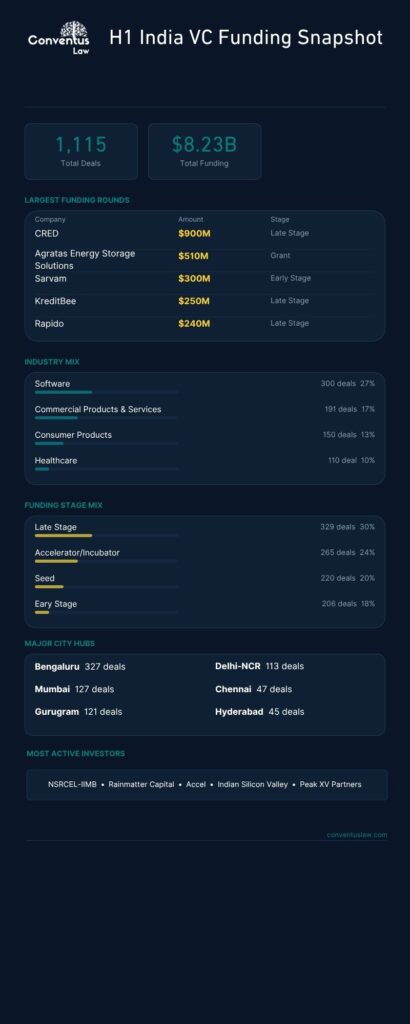
The distribution of equity capital across corporate development phases in H1 reveals a pronounced concentration at the mature end of the enterprise lifecycle. Later Stage VC transactions commanded the clear majority of market liquidity, accounting for 329 total deals. Within this specific cohort, 224 corporate entities executed transactions with fully transparent financial terms, generating a verified aggregate capital deployment of $8,237.75 million. This represents a dominant 64.82% of all factually recorded venture capital in the country during the half-year period.
This overwhelming tilt toward late-stage allocations is directly tied to the shifting regulatory environment governing Indian private equity. Over the past year, SEBI has consistently introduced stricter reporting mandates for Alternative Investment Funds (AIFs), focusing heavily on ultimate beneficial ownership (UBO) transparency and the prevention of regulatory arbitrage. Concurrently, high-profile governance failures across the domestic startup ecosystem have prompted institutional allocators to mandate forensic-level legal and financial audits prior to capital deployment.
Consequently, mature corporate structures that possess established compliance frameworks, robust internal controls, and clear pathways to a public listing via an Initial Public Offering (IPO) are capturing the lion’s share of private liquidity. Investors are deliberately paying a premium for regulatory compliance, treating mature operational entities as defensive safe havens against the threat of statutory penalties or capital lock-ups.
Conversely, the foundational tiers of the market exhibit high deal velocity but capture significantly less absolute capital. Early Stage VC transactions logged 206 deals, with 130 disclosed rounds generating an aggregate capital volume of $1,649.09 million. Seed Rounds recorded 220 transactions, where 178 disclosed entities accumulated a total value of $654.33 million.
While the volume of these early-stage transactions reflects a healthy pipeline of operational activity, the absolute dollar exposure remains insulated. This trend highlights the structural impact of the relaxation and ultimate repeal of legacy tax provisions, such as the contentious “Angel Tax” framework. The removal of these systemic tax litigation risks has successfully sustained the absolute velocity of early-stage deal-making. However, macroeconomic crosswinds and the high compliance costs associated with scaling early ventures have kept overall dollar allocations modest compared to the late-stage segment.
Software’s Regulatory Premium: Enterprise Value in an Asset-Light Regime

“Measures are needed to propel organisations to shift to India not just from an operational front but a commercial / product front as well.”
Archana Balasubramanian,
Partner at Agama Law Associates,:
Sector-specific capital allocation during H1 reinforces the market’s preference for predictable, scalable, and cross-border corporate models. The Software vertical continues to serve as the primary engine of both deal volume and capital acquisition in the Indian market, capturing 300 total transactions—representing 26.91% of the entire 1,115 transaction pool. Financially, 146 software corporations disclosed their funding metrics, yielding a verified aggregate capital intake of $2,421.59 million.
The software sector’s overwhelming dominance is amplified by its alignment with India’s evolving Foreign Direct Investment (FDI) framework. Software development and software-as-a-service (SaaS) business models benefit significantly from the FDI “automatic route,” which allows up to 100% foreign equity participation without requiring prior government approval. This streamlined regulatory path bypasses the lengthy administrative delays that frequently complicate capital inflows into more heavily regulated sectors, such as fintech or multi-brand retail.
Furthermore, the implementation of the Digital Personal Data Protection (DPDP) Act has provided international venture syndicates with a clear, codified compliance baseline. Software enterprises that align their data architectures with these statutory privacy mandates present a highly predictable risk profile, making them attractive targets for cross-border private equity.
Traditional industrial and commercial asset classes maintained a steady, though less dominant, position within the H1 capital market. Commercial Products secured 105 total transactions, with 57 disclosed rounds amassing $915.33 million in aggregate value. Consumer Non-Durables generated 111 total transactions, of which 78 disclosed rounds accounted for $849.41 million.
To elevate the quality of incoming foreign investment, legal experts argue that India must expand beyond its role as a back-office hub. As Archana Balasubramanian, Partner at India based law firm Agama Law Associates, notes:
“We are seeing India led development without the capital sitting in India. Measures are needed to propel organisations to shift to India not just from an operational front but a commercial / product front as well. Improvement in IP enforcement and specific regulations surrounding AI based development can go a long way in improving the quality of FDI seen in India.”
The highly regulated financial services space also maintained a solid institutional foothold, with the Other Financial Services vertical registering 44 total deals. Within this sector, 31 fully disclosed financings brought in $720.11 million. This concentration of capital reflects targeted late-stage consolidation within neo-banking, digital lending, and automated financial infrastructure platforms, where investors are backing established operators that have successfully navigated SEBI and Reserve Bank of India (RBI) licensing requirements. Commercial Services rounded out the top sectors, recording 86 transactions, with 42 disclosed rounds contributing $635.63 million in corporate and enterprise support.
Geographic Sanctuaries: The Hegemony of Bengaluru’s Corporate Ecosystem
The spatial distribution of Indian venture capital during H1 highlights a highly concentrated geographic landscape, with specific municipal boundaries acting as clear corporate strongholds. Bengaluru (inclusive of data entries categorised under both the Bangalore and Bengaluru nomenclatures) remains the undisputed capital of the country’s venture ecosystem. The municipal region accounted for 327 transactions out of the 1,115 total records. On a financial level, 199 of these corporate entities provided full disclosures, resulting in a verified capital aggregation of $3,379.83 million. This represents an astonishing 41.03% of all verified venture capital deployed across the nation during H1.
Bengaluru’s status as a premier venture capital hub is reinforced by a deeply entrenched institutional network effect. The city boasts a highly dense concentration of specialized technology-focused legal practices, corporate secretaries, and compliance advisors who are well-versed in structuring cross-border equity instruments, such as Compulsorily Convertible Preference Shares (CCPS). This localized legal infrastructure dramatically reduces transaction friction, shortens deal-closing timelines, and ensures smooth compliance with the Reserve Bank of India’s Foreign Exchange Management Act (FEMA) regulations.
The commercial capital of Mumbai forms the secondary core of H1 deal execution, registering 121 corporate transactions. Financial disclosures were executed by 77 entities within the municipality, accumulating a verified asset base of $1,241.42 million. Mumbai’s venture landscape remains heavily anchored by enterprise software, fintech, and financial services, drawing on the city’s status as India’s primary banking and regulatory hub.
The National Capital Region (NCR) exhibits a strong but structurally fragmented corporate footprint split across multiple administrative boundaries. Gurugram registered 76 transactions, with 55 entities disclosing an aggregate funding baseline of $700.00 million. The municipal territory of New Delhi registered 60 transactions, with 30 disclosed rounds yielding $231.29 million, while broader regional entries for Delhi added 52 transactions and $290.52 million across 37 disclosed financing rounds. Combined, the wider capital region represents 188 transaction touchpoints, serving as an institutional counterweight to the southern tech corridors.
Summary of H1 Market Dynamics
The corporate transaction record for H1 shows an Indian venture capital market operating on two distinct tracks. At the surface level, a high-volume pipeline of early-stage software and technology startups continues to drive deal velocity across major urban centers. Beneath the surface, however, institutional capital is clustering heavily within late-stage deals and proven metropolitan hubs like Bengaluru. Navigating this landscape requires a sophisticated understanding of how shifting regulatory frameworks, tax policies, and compliance mandates are reshaping investor risk profiles and steering the flow of private liquidity across the country.
Data Limitations and Analytical Impact
A critical evaluation of the source material reveals substantial systemic information deficits that compromise overall financial modelling accuracy for the H1 review. Most notably, out of the 1,115 recorded transaction fields, exactly 472 entries completely omit the specific capital volumes deployed deal size. This lack of disclosure means that 42.33% of the transaction cohort is fundamentally unpriced in the factual log.
*Statistical Modelling via Estimated Projections
To reconcile the structural gaps created by the 472 unpriced venture transactions, statistical models can be used to generate Estimated Projections. These projections offer a clearer view of the total hidden liquidity moving through the ecosystem during H1:
- Aggressive Mean-Driven Extrapolation: If we assume the 472 undisclosed deals match the broader factual average of $12.81 million per transaction, the unmapped capital pool is estimated at $6,047.00 million. Combining this with the verified baseline provides an Estimated Projection of $14,284.75 million for total market capital deployment.
- Conservative Median-Driven Extrapolation: Given the high volume of early-stage, low-value deals that typically remain undisclosed, applying the median value of $2.44 million serves as a more conservative baseline. Imputing this across the 472 missing entries uncovers an estimated latent capital pool of $1,151.68 million. This adjusts the total market capitalization Estimated Projection to a more realistic and insulated baseline of $9,389.43 million.
