
Motorcyclists account for a disproportionate share of serious traffic injuries because they ride without the structural protection that passenger vehicles provide. There is no steel frame, airbag, or seat belt separating a rider from the road or another vehicle.
National data illustrates the difference in 2023 data; motorcyclists were killed at a rate of 31.39 fatalities per 100 million vehicle miles traveled, compared with 1.13 fatalities for passenger car occupants. Making riders are nearly 28 times more likely to die in a crash than people traveling in passenger cars.
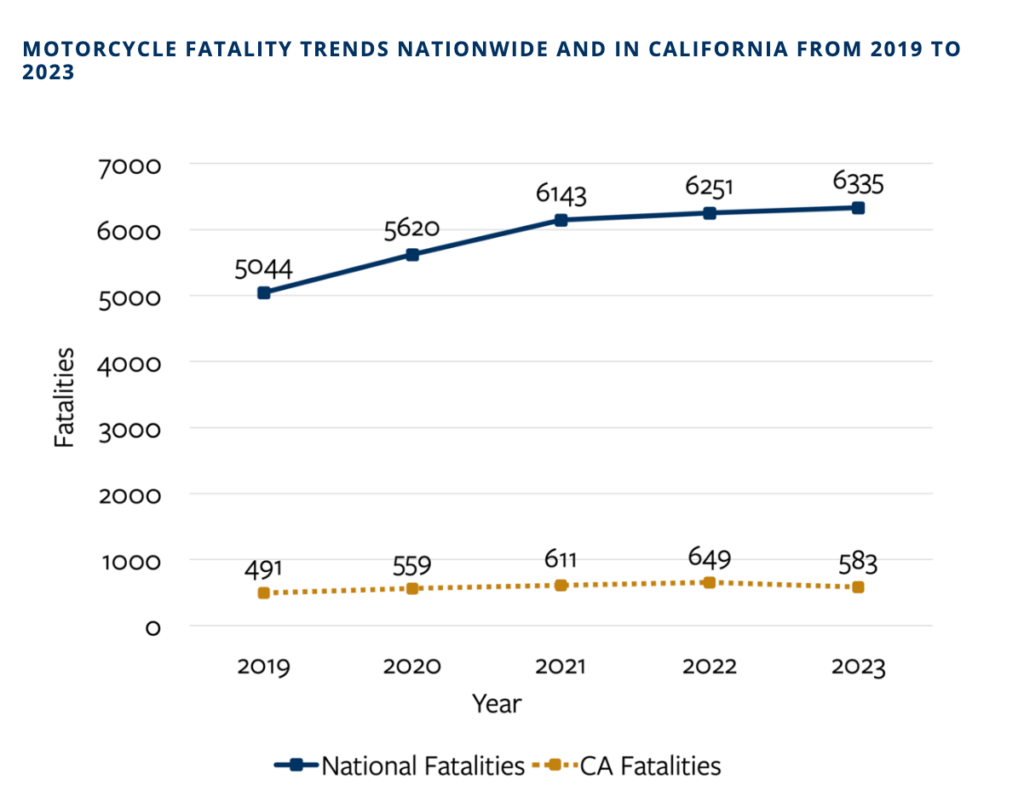
Image Source: https://safetrec.berkeley.edu/2025-safetrec-traffic-safety-facts-motorcycle-safety
In California alone, 583 motorcyclists were killed in traffic crashes in 2023, accounting for 14% of all motor vehicle fatalities in the state. As a result, crashes that leave a car with relatively minor damage can cause life-changing injuries for a motorcyclist.
The Physics of Motorcycle Crashes Produce More Severe Injuries
A car accident that would produce a minor soft tissue injury for the driver of an enclosed vehicle can produce catastrophic, life-altering harm for a motorcyclist because the rider has no structural protection between their body and whatever they impact.
Road rash, traumatic brain injuries, spinal cord damage, fractured limbs, and internal organ injuries are all common outcomes in motorcycle crashes at speeds where a car occupant may walk away with only bruising. This difference in injury severity is well documented in crash data and reflected in the medical records of riders who sustain serious injuries in collisions that leave comparatively minor damage to the other vehicle.
The consequences extend well beyond the emergency room.
Long-term rehabilitation, future medical care, lost earning capacity, and permanent disabilities often become central issues when valuing a motorcycle injury claim. For riders seeking legal guidance after a serious collision, a California car accident lawyer, such as The May Firm attorneys focuses exclusively on personal injury litigation. The firm has represented more than 10,000 clients, recovered over $400 million for injury victims, and includes attorneys recognized by organizations such as Super Lawyers Rising Stars and the Million Dollar Advocates Forum.
Larger medical expenses drive larger settlement values
Settlement value is directly tied to provable damages. When a motorcycle accident produces hospital stays, surgeries, extended rehabilitation, long-term physical therapy, and potentially a lifetime of care for a permanent disability, the documented medical expenses alone can reach levels that standard car accident claims seldom approach.
Add future lost earning capacity for a rider whose injuries prevent a return to their prior occupation, and the damages calculation in a serious motorcycle case can run into figures that explain why these claims, when handled correctly, resolve at higher values than the median personal injury settlement.
Bias against motorcyclists is a documented problem in injury claims
Defense attorneys and insurance adjusters are aware of research showing that jurors and even some claims professionals carry implicit bias against motorcyclists, assuming recklessness or risk-taking without specific evidence of either. This bias operates in the background of motorcycle injury claims and affects settlement offers in ways that are not always visible.
Combating this bias requires a well-built liability case that establishes clearly what the other driver did, separates that conduct from any assumptions about motorcyclist behavior generally, and presents the injured rider as a specific, identified individual rather than a generic representative of a category associated with risk.
Helmet use, lane-splitting, and comparative fault arguments
California law permits motorcycle lane-splitting under conditions defined by the California Highway Patrol, and this legal status does not automatically make lane-splitting a basis for comparative fault. However, defense counsel frequently attempts to use any non-conventional riding behavior as a fault allocation argument.
Similarly, helmet use, or the absence of it for adults who are not required by California law to wear one, can be raised as a contributing factor to head injury severity in cases where that injury is a central element of damages. California’s comparative fault law means that even a rider assigned partial fault can still recover damages reduced proportionally, but minimizing the comparative fault exposure through strong liability development remains an important case-building priority.
Why insurance layering matters in motorcycle claims
Motorcyclists who are hit by underinsured drivers face a specific practical problem. A car driver carrying minimum personal auto insurance limits may have far less coverage than the actual damages in a serious motorcycle crash require. Identifying and accessing the injured rider’s own underinsured motorist coverage, if present, is an important early step in any serious motorcycle case.
In commercial vehicle cases involving a truck or bus striking a motorcycle, the commercial carrier’s policy limits are substantially higher, and the federal regulatory framework adds additional evidence sources through ELD data and inspection records that can significantly strengthen the liability case.
What The May Firm brings to California motorcycle cases
Robert May, who founded The May Firm after a personal experience as a violent injury victim, understands what a serious injury takes from a person’s life in concrete terms, not just in abstract legal frameworks. The firm has recovered more than $400 million for California clients across 10,000-plus cases, with results that include a $6 million settlement involving traumatic brain injury and spinal damage, the category of injury that motorcycle crashes disproportionately produce.
With 9 offices across California, a “we come to you” policy for clients unable to travel, and representation available 24/7 in both English and Spanish, the firm is structured specifically to make serious legal representation accessible to injured riders regardless of where in California the crash occurred or how the injury has affected their mobility.
What injured riders and their families should do first
Seek emergency medical care, even if the injury does not immediately appear life-threatening, because adrenaline after a crash can mask serious internal or neurological injuries that present fully only hours later. Document the scene with photographs if physically possible, including the position of all vehicles, visible skid marks, and any road hazards. Preserve the motorcycle in its post-crash state rather than authorizing repairs, since it is physical evidence of how the crash occurred and the force involved.
The claim should begin as early as possible. Evidence is time-sensitive, at-fault driver insurance information needs to be confirmed, and the investigation that builds a strong motorcycle claim is more effective the sooner it starts.
What to expect in terms of timeline
Serious motorcycle injury cases rarely resolve in weeks. When injuries are significant and future medical needs are still developing, the appropriate timeline for resolution often extends to months or longer, since accepting a settlement before the full scope of an injury is understood means permanently giving up the right to additional compensation. The May Firm advises clients to treat patience as a strategic advantage in serious cases rather than a burden, since the difference between an early, inadequate settlement and a fully supported one is often measured in significant dollars.