
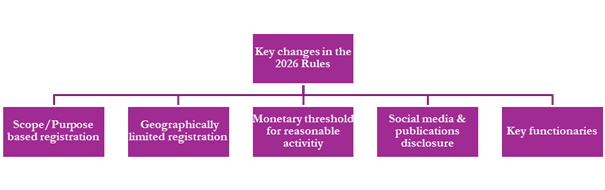
Summary: This article examines the Foreign Contribution (Regulation) Amendment Rules, 2026, which came into force in June 2026. These rules represent a significant recalibration of FCRA, introducing increased compliance obligations for registered organisations. This article analyses the key changes introduced, inter alia: scope-based and State-specific registration requirements that restrict organisations to enumerated purposes and designated territories; a monetary threshold of INR 10 lakh for “reasonable activity” that creates vulnerability for smaller organisations; enhanced disclosure obligations covering social media, publications, and ultimate donor details; and restrictions on foreign nationals serving as key functionaries. These changes collectively tighten the compliance architecture surrounding foreign-funded, not-for-profit work in India and necessitate urgent organisational engagement with transitional compliance obligations under the 2026 Rules.
The Foreign Contribution (Regulation) Act, 2010 (“FCRA”), is the primary instrument through which India regulates the flow of foreign funds to non-governmental organisations undertaking not-for-profit activities in India. In 2026, the FCRA underwent two simultaneous legislative interventions: the Foreign Contribution (Regulation) Amendment Rules, 2026 (“2026 Rules”), passed in June 2026, and the Foreign Contribution (Regulation) Amendment Bill, 2026, introduced in the Lok Sabha in March 2026, but still pending (“2026 Bill”).[1] Together, they represent the most comprehensive recalibration of the FCRA framework since the sweeping 2020 amendments. This article examines the legal changes introduced by the 2026 Rules and their implications for FCRA-registered organisations considering the new scope and territorial restrictions.
Restricted Registration – A Paradigm Shift
The most structurally significant change in the 2026 Rules is the new sub-rule (1B) of Rule 9, which requires FCRA registration certificates to specify the purpose for which registration is granted to an organisation. The 2026 Rules have introduced an updated schedule, outlining the permissible purposes for receiving foreign funds under the FCRA. All new applicants must now indicate the scheduled activities they intend to undertake, while existing organisations must, within one year, submit an intimation in new Form FC-6F specifying, inter alia, the purposes for which they seek to retain their registration.
The new schedule appended to the 2026 Rules sets out five categories of permissible purposes:
- Religious activities, such as construction, renovation and maintenance of places of worship, conduct of religious education and meditation retreats, and inter-faith dialogue and harmony-building programmes;
- Cultural activities, such as archaeological exploration and conservation of monuments and heritage sites, documentation and preservation of folk songs and dances, and training and capacity-building for artisans and craftspersons;
- Economic activities, such as agricultural development programmes, and provision of microfinance, microcredit and community savings institutions for poor households;
- Educational activities, such as establishment and management of educational institutions, and provision of scholarships and financial aid for disadvantaged students; and
- Social activities, such as establishment and operation of hospitals and community health centres, disaster relief, legal aid clinics and paralegal training programmes.
The schedule is detailed and broadly drafted, and its legal significance cannot be overstated. Since the schedule is exhaustive and not illustrative, any activity that falls outside the enumerated list would not be eligible for FCRA-related funding. Organisations must carefully assess and review the scope of their current activities to determine whether they can be mapped onto the listed purposes or whether they effectively fall outside the permitted scope of the FCRA, thereby jeopardising their foreign funding and operational continuity. In addition to scope-based restrictions, sub-rule (1B) of Rule 9 further requires the certificate of registration to specify the States/ Union Territories for which registration is granted. Every new application must now identify the States or Union Territories in which the organisation proposes to operate, thereby limiting operations to specified jurisdictions.
These changes are applicable to new organisations seeking registration under the FCRA. However, organisations that have existing FCRA registrations must file Form FC-6F within one year, specifying the purposes and States for which they wish to retain their registration. Failure to comply is likely to have an adverse impact on registration, although regulatory clarifications and extensions may be provided in the coming months. Additionally, there are concerns that the scope-based and State-specific registration requirements may constitute a restriction on the existing rights of organisations already registered under the FCRA. Neither the FCRA nor the 2026 Bill makes any reference to purpose-specific or State-specific registrations, and the new one-year deadline imposed on existing organisations to comply with the changes may prove operationally challenging, particularly for larger organisations operating across multiple sectors and States.
Enhanced Transparency and Management Responsibility
The 2026 Rules have amended Form FC-4, the mandatory annual return, which now requires disclosure of the organisation’s official website and social media accounts. This change carries significant implications for FCRA-registered organisations. A new entry requires disclosure of all publications by the organisation or its key functionaries during the year. While the FCRA prohibits an organisation from engaging in the production or broadcast of news or current affairs content, mandating express disclosure of social media handles and publications may cause digital communications and public advocacy of organisations receiving foreign contribution to come under heightened scrutiny. Organisations whose social media activity is perceived as political in nature or as falling outside their registered purposes may be exposed to adverse regulatory action. The duty to report publications by key functionaries independently of the organisation broadens the FCRA’s ambit to encompass personal expressions of individuals, effectively conflating the activities of key functionaries with those of the organisation. This may lead to a chilling effect and incentivise self-censorship. Additionally, Form FC-4 has been amended to require organisations to provide details of ultimate donors in the case of donor-advised funds and other intermediary remittance vehicles, significantly increasing transparency regarding the true source of foreign funds.
The 2026 Rules also defines ‘key functionary’, consistent with the definition proposed in the 2026 Bill, to include directors, partners, trustees, karta, office bearers, members of governing bodies, and any other person who has control over or responsibility for the management or affairs of the organisation. This definition replaces inconsistent references to members of executive or governance councils, office bearers, and key functionaries as used prior to the amendment. However, the 2026 Rules additionally include an explanation stating that an organisation which has foreign nationals, other than persons of Indian origin, as its key functionaries shall not ordinarily be considered eligible for grant of registration or prior permission, unless otherwise specified by the Central Government. This restriction carries significant implications for internationally governed organisations, particularly those with global boards or advisory structures that include foreign nationals in decision-making roles. Such organisations may have to restructure their governance arrangements to ensure continued operations in India, in compliance with the evolving FCRA landscape.
The new Rule 14A also introduces a monetary threshold for determining whether an organisation has undertaken “reasonable activity” when considering cancellation under Section 14 and renewal under Section 16 of the FCRA. An organisation shall be deemed to have undertaken reasonable activity if it has utilised foreign contribution of not less than INR 10 lakh in the last two financial years. However, the 2026 Rules also clarify that “reasonable activity” includes only those activities that were undertaken out of, or by utilising, foreign contribution received in accordance with the Act. Domestically funded activities would not count towards this threshold. This creates a specific risk for smaller organisations, as well as those whose foreign receipts have been delayed or withheld by regulatory authorities. If these entities are unable to demonstrate expenditure of INR 10 lakh in foreign-funded activities over two years, they may be at risk of non-renewal or cancellation of their FCRA registration.
Concluding Remarks
The 2026 Rules represent an operationally significant set of regulatory changes for organisations registered under the FCRA. The introduction of scope-based registration within a limited geographical context, coupled with the enhanced Form FC-4 disclosure requirements, collectively tightens the compliance architecture around foreign-funded work in India. The 2026 Rules, taken together with the 2026 Bill, chart a trajectory towards greater reporting, transparency, and government oversight. Organisations must urgently engage with the compliance obligations under the 2026 Rules and also prepare for the changes proposed by the 2026 Bill, as and when it is enacted.

For further information, please contact:
Ritika Rathi, Partner, Cyril Amarchand Mangaldas
[1] Our analysis of the 2026 Bill can be accessed at The FCRA Amendment Bill 2026: Part I – Asset Vesting | Private Client and The FCRA Amendment Bill 2026: Part II – Compliance and Other Changes | Private Client.