
Australia – Formula For Infringement? Australian Federal Court Confirms a2 Milk’s Trade Marks Are Not Descriptive And Have Been Infringed By Care A2.
On 23 April 2026, the Federal Court published its highly anticipated decision in Care A2 Plus Pty Ltd v The a2 Milk Company Limited (No 2) [2026] FCA 475, finding that Care A2 Plus Pty Ltd’s (Care A2) use of the “A2+” mark on its infant formula products infringed a2 Milk Company’s (a2MC) registered “a2 Milk” word mark and “a2” logo.
The Court also ordered additional damages against Care A2 and held that it contravened the Australian Consumer Law (ACL).
Significantly, the decision confirmed the Court’s earlier finding in The a2 Milk Company Ltd v LD&D Australia Pty Ltd (2021) 164 IPR 293 that a2MC’s registered “a2” marks were not directly descriptive of a characteristic of the milk products sold under them and were therefore validly registered.
Background
a2MC is a premium New Zealand dairy company which has operated in Australia since 2003, offering a wide range of milk products including infant formula. Care A2 manufactures and distributes infant and toddler formulas in Australia.
In February 2023, a2MC brought proceedings against Care A2 alleging infringement of its following five registered trade marks (a2MC Marks) and contraventions of the ACL:
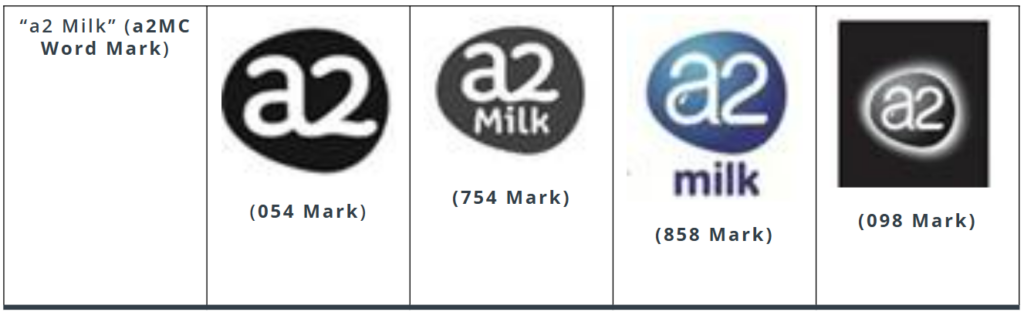
In response, Care A2 brought separate proceedings against a2MC, challenging the validity of those marks on grounds including that they were not capable of distinguishing, were likely to mislead or deceive, and had become descriptive.
Central to the dispute is the scientific composition of milk.
Historically, cows produced milk containing only the A2 ß-casein protein. However, a natural mutation introduced the A1 variant, which has since spread throughout global herds. Ordinary cow’s milk sold in Australia now contains a mixture of A1 and A2 ß-casein proteins.
There is a growing body of literature suggesting that consuming milk containing only A2 ß-casein protein confers certain digestive and health benefits. That is, it is the absence of the A1 ß-casein protein in a cow’s milk that confers the health benefits.
By commencing the above proceedings, both parties sought to establish exclusive rights to use their respective marks in connection with such products.
The a2MC Marks Are Not Descriptive
Care A2’s core argument — across both its invalidity claim and its defence to infringement — was that “a2/A2” is descriptive of milk containing only A2 ß-casein protein.
The Court rejected this for three principal reasons:
- Not a scientific term: “a2/A2” is not a scientific or descriptive term for milk lacking the A1 ß-casein protein. Without the words “ß-casein protein” attached, “a2/A2” is as meaningless as presenting “A” without the word “vitamin”.
- Descriptive use was not representative of ordinary consumers: Although some academic journals and publications showed descriptive use of “a2/A2”, the Court found that the relevant ordinary consumer does not read scientific literature and is unfamiliar with the protein structure of milk. Thus, such descriptive use did not reflect the ordinary consumer’s understanding.
- The Macquarie Dictionary definition is inaccurate: Although the Macquarie Dictionary defines “a2 milk” as “milk which contains only A2 β-casein proteins, thought to be less allergenic than milk which contains A1 proteins”, a2MC’s expert — a Professor of Linguistics and official consultant to the Oxford English Dictionary — demonstrated that over 90% of references to “a2/A2” referred to a2MC and its products, with only around 10% potentially descriptive. This was insufficient to establish that the ordinary consumer understood “a2/A2” as a descriptive term. It was therefore wrong for Macquarie Dictionary to include “A2” referring to “milk” in the dictionary, without having “A2” referring to the “ß-casein protein” as the main headword.
Trade Mark Infringement
a2MC alleged that Care A2 infringed its trade marks by selling, supplying and promoting infant formula under or by reference to the “A2”, “A2+” and/or “Care A2+” marks, such as depicted below:
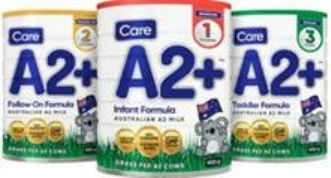
The Court first found that Care A2 used two separate marks — “Care” and “A2/A2+” — rather than one composite “Care A2+” mark. On the products, “A2/A2+” was always prominently and centrally displayed and larger than “Care”. In other uses, “A2+” sometimes appeared independently of “Care” altogether.
The Court then assessed substantial identity and deceptive similarity. None of the a2MC Marks were found to be substantially identical with the A2+ Mark — even minimalist two-letter alphanumeric marks can be distinguished by capitalisation, the presence of a mathematical symbol, or a splodge or droplet device.
On deceptive similarity, the Court held that the A2+ Mark was deceptively similar only to the a2MC Word Mark and

(the 054 Mark). The other marks were distinguished as they incorporated additional elements.
Trade mark infringement was accordingly established in respect of the Word Mark and 054 Mark.
Given Care A2’s flagrant disregard for the a2MC Marks, and to deter similar trade mark infringements, the Court also awarded additional damages.
Invalidity
Care A2’s invalidity grounds — including that the a2MC Marks were not capable of distinguishing, were likely to mislead or deceive, and had become descriptive — all depended substantially on the Court finding that “a2/A2” was descriptive. Having rejected that premise, the Court dismissed all invalidity grounds.
Contravention of the Australian Consumer Law
Consistent with its reasoning on deceptive similarity, the Court found that Care A2 had engaged in misleading or deceptive conduct and made false or misleading representations —in particular, that its products originated from or were approved by a2MC.
The Court noted that purchasing decisions in retail environments are often made quickly and under the influence of prominent visual cues, rather than through detailed scrutiny of scientific information. Evidence of actual consumer confusion and Care A2’s failure to explain why it adopted the “Care A2+” mark — which meant that the inference of an intention to deceive on the part of Care A2, as drawn by a2MC’s expert, was unchallenged and could not be displaced — further supported this finding.
Key Takeaways
- Descriptive or distinct: Whether a mark is descriptive or distinctive requires careful analysis of the relevant consumer group and the context of prior use of the mark.
- Separate marks or a composite mark: How a trade mark is actually used, including its size, positioning and surrounding context, determines whether there is use of several separate marks or a single composite mark.
- Minimalist alphanumeric marks: Disputes involving short alphanumeric marks require detailed visual, aural and conceptual comparison to avoid unduly extending the scope of the registered monopoly.
- Expert evidence: Independent expert witnesses can play a decisive role in trade mark and ACL proceedings, providing objective assessment of distinctiveness and circumstances of trade mark use.

For further information, please contact:
Shehana Wijesena, Partner, Bird & Bird
shehana.wijesena@twobirds.com