
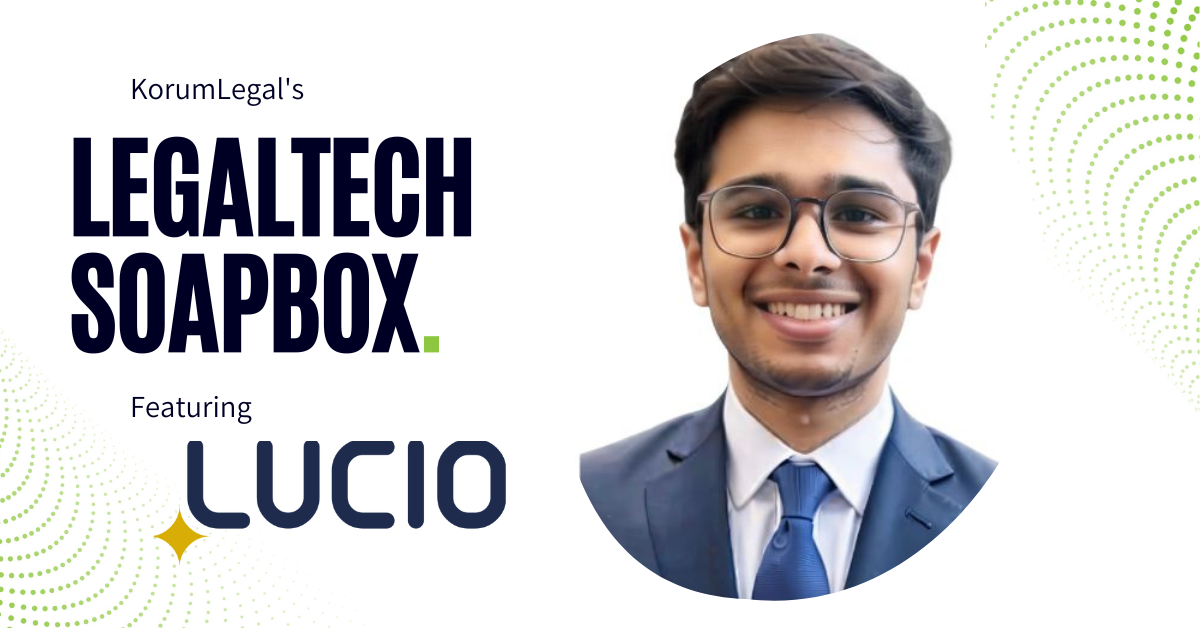
1. Hi Darsan, tell us the story behind LucioAI.
Between 2020 and 2023, Vasu and I observed that around 20% of lawyers joining law firms were leaving their roles within two years. We interviewed approximately 30 such lawyers and discovered that their burnout wasn’t driven by long hours, but by the monotony of routine work. This insight inspired us to build solutions that would bring the joy of practising law back to lawyers.
We began working on the idea in 2022, just as generative AI (GenAI) was scaling rapidly and generating global excitement. Yet the legal profession remained bogged down by endless hours of either mundane, repetitive tasks – such as contract reviews, due diligence, and regulatory filings – or high-intensity, all-consuming work like case law research and evidence gathering. These tasks aren’t just time-intensive; they detract from the strategic, high-impact work that truly matters.
Vasu and I saw a clear opportunity. With GenAI accelerating, this felt like the perfect moment to redefine how legal services are delivered. However, existing GenAI tools were unreliable for legal use they were fast, but lacked legal precision, and dynamic, yet not designed for legal workflows. We spent months brainstorming with lawyers to deeply understand their pain points and envision how GenAI could be meaningfully tailored to their needs. It became clear that the legal industry required an AI platform with verifiable outputs, secure infrastructure, and workflow automation that genuinely reflects how lawyers, law firms, and in-house teams operate.
That’s how LucioAI was created- as a legal intelligence platform, not just another AI chatbot. Designed for lawyers, with lawyers, and by lawyers, LucioAI automates drudgery, supports high-impact work, and empowers lawyers to focus on what they do best: solving complex problems and driving meaningful outcomes. It has been incredibly rewarding to see top-tier law firms and in-house teams adopt LucioAI and reshape the way they work and this is just the beginning!
2. What are the services or products that LucioAI provides?
LucioAI is an AI-powered legal intelligence platform that enables law firms and in-house legal teams to extract, analyse, and act on legal data faster and with greater accuracy. Features such as Sorting for document organisation, Briefcase for rapid research across thousands of documents, and Redline Issues for tracking revisions and analysing their implications allow LucioAI to streamline legal work at scale. The platform also enables interactive, AI-driven document review and due diligence across vast volumes of files.
Beyond this, LucioAI offers powerful tools including data-room insights for document management, chronologies that extract dates and events from large volumes of material, robust OCR capabilities, contract compliance checks, workflow automation, and multilingual legal translation. Backed by top-tier security and compliance standards, LucioAI ensures data privacy while transforming how legal work is delivered. Ultimately, it’s about helping lawyers practise law more thoughtfully and effectively.
3. How does the above optimise the daily operations of an in-house legal team/ law firm?
LucioAI optimises daily legal operations by eliminating repetitive tasks and improving accuracy across three core service areas: transactions, disputes, and advisory work.
For transactional lawyers, LucioAI accelerates due diligence by enabling the review of hundreds of documents in minutes, streamlines contract negotiations through AI-driven redline tracking, and enhances the ability to manage and organise large volumes of documentation. In disputes, LucioAI strengthens legal research by enabling instant queries across legislation and judgments, simplifies case preparation by generating chronologies from dispersed materials, identifies key legal issues, analyses judicial precedents, prepares cross-examination questions, and uncovers relevant facts across thousands of documents.
In advisory work, LucioAI supports the creation of query repositories to monitor regulatory changes, enhances insight generation from legal databases, and empowers lawyers to pressure-test strategic hypotheses by identifying risks, trends, and patterns. Together, these capabilities allow legal teams to operate with greater speed, precision, and confidence.
4. What do you believe will be the most significant change in how in-house legal teams use technology in the next 10 years?
In our view, the legal profession will shift from labour-intensive processes to precision-driven efficiency over the next decade. We see a strong appetite among both junior and experienced lawyers to use AI to automate routine tasks, freeing up time to hone strategic thinking, courtroom craft, and deal-shaping creativity. Lawyers will increasingly rely on GenAI tools to analyse historical case outcomes, regulatory trends, and precedents, enabling advice grounded in rigorous, reliable research.
GenAI will also dramatically accelerate expertise. Platforms like LucioAI can parse vast archives of judgments, contracts, and filings in seconds, distilling insights and identifying patterns that might otherwise go unnoticed.
Crucially, error minimisation will become systemic. Overwork and information overload—often the cause of embarrassing or costly mistakes—will be mitigated by built-in AI safeguards. LucioAI, for example, helps cross-verify clauses and identify inconsistencies across documents.
While we do not believe AI will reduce job opportunities in the legal profession, we do expect AI-enabled lawyers to significantly outperform those who do not adopt these tools. Lawyers who use AI to elevate rigour and decision-making will gain a clear competitive advantage, ultimately enhancing the profession’s efficiency and helping it move beyond its reputation for outdated ways of working.

KorumLegal is a boutique legal consultancy committed to providing value innovation in legal service delivery. The legal services industry is continuing to change with ‘NewLaw’ – and clients are seeking more innovative and cost-effective solutions without compromise on experience and quality
